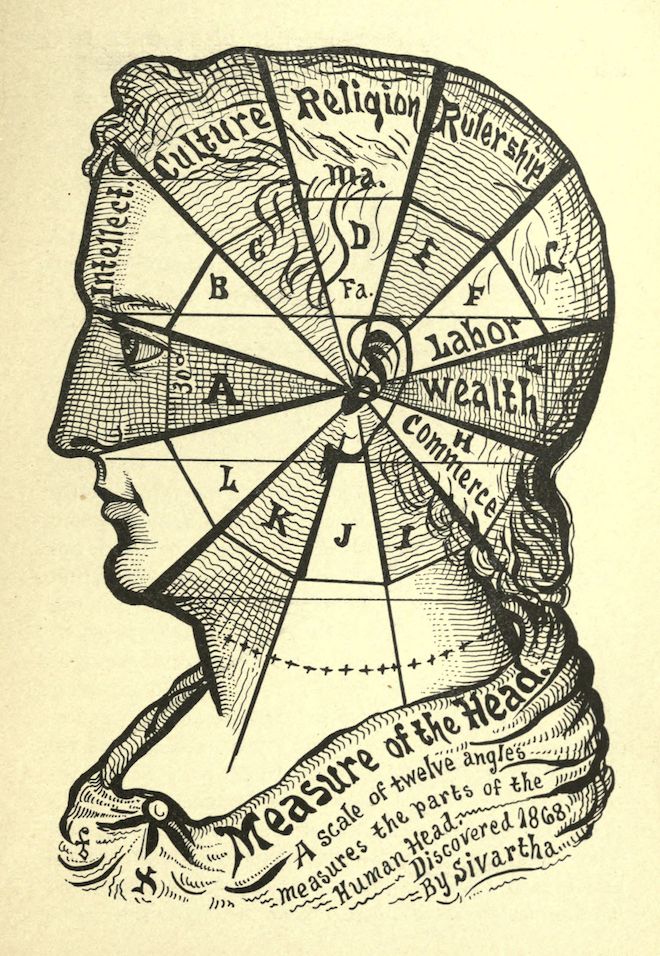
This is a vintage illustration, likely from the late 19th or early 20th century, depicting a profile of a man's head overlaid with a complex diagram. The head is rendered in a detailed, cross-hatched style, showing the contours of the face, forehead, and hair. The diagram consists of a circular chart divided into twelve wedge-shaped sections, each labeled with a different concept: "Intellect", "Culture", "Religion", "Rulership", "Labor", "Wealth", "Commerce", and others. Lines radiate from the center of the circle, intersecting the sections and labeled with letters (A through L). The diagram appears to be a phrenological chart, attempting to map different mental faculties to specific areas of the skull. Below the head, there's a decorative banner with text. The text reads: "Measure of the Head. A scale of twelve angles measures the parts of the Human Head Discovered 1868 by Sivartha". The banner is adorned with flourishes and decorative elements. The overall style is reminiscent of scientific illustrations from the Victorian era, with a focus on detail and a somewhat ornate aesthetic. The image is monochromatic, with a sepia tone, giving it an aged appearance.