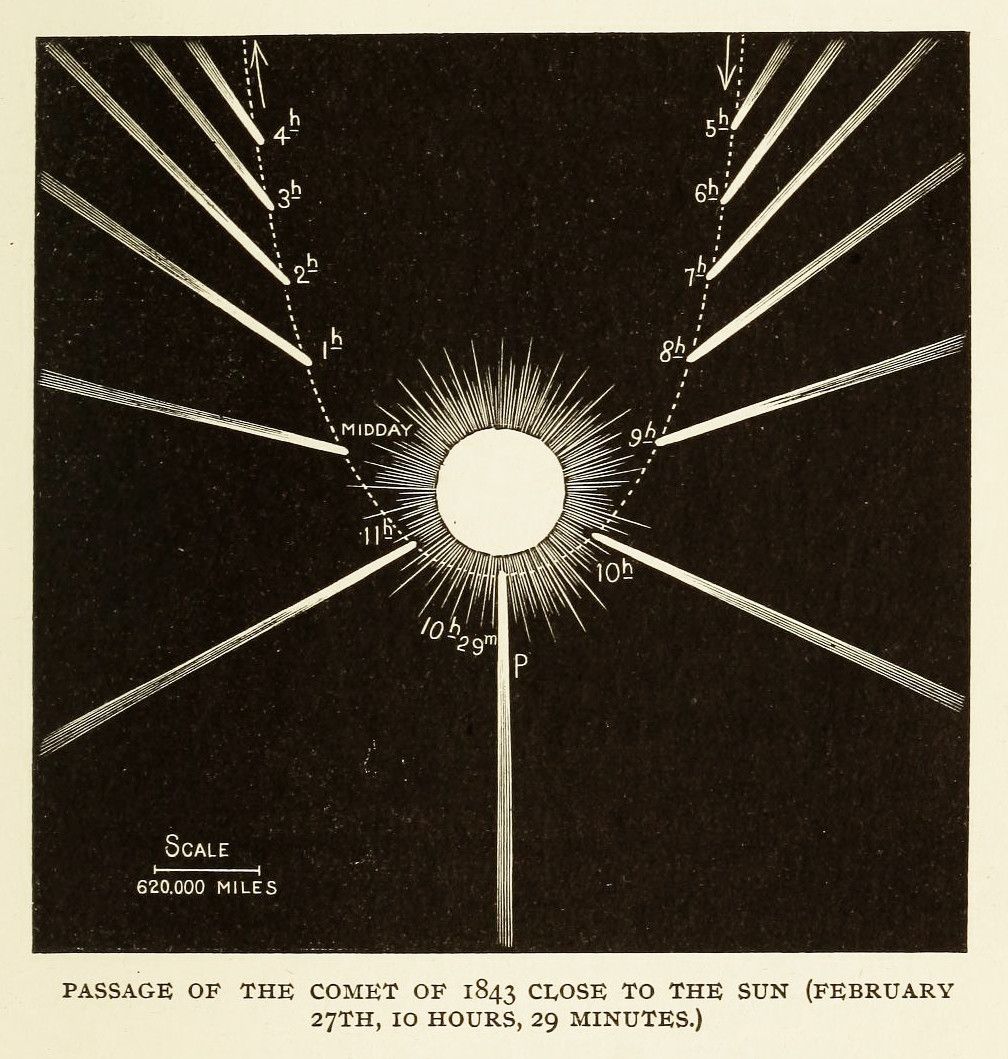
The image is a vintage astronomical diagram depicting the passage of the comet of 1843 close to the sun. The background is black, representing space. The sun is represented by a bright, circular shape in the center of the image, radiating numerous short, straight lines outwards, simulating solar flares or corona. Extending from the sun are several bright, elongated shapes representing the comet's tail at different times. These tails are labeled with time markings: '1h', '2h', '3h', '4h' on the left side, and '5h', '6h', '7h', '8h', '9h', '10h' on the right side. There's also a marking '10h 52m' and 'P' near the bottom. The tails are depicted as radiating outwards, becoming wider and fainter as they extend from the sun. Below the diagram, there's text that reads: 'PASSAGE OF THE COMET OF 1843 CLOSE TO THE SUN (FEBRUARY 27TH, 10 HOURS, 29 MINUTES.).' In the lower-left corner, there's a 'SCALE' indicating '620,000 MILES'. The overall style is reminiscent of 19th-century astronomical illustrations, with a focus on clarity and precision in depicting the comet's trajectory and tail.