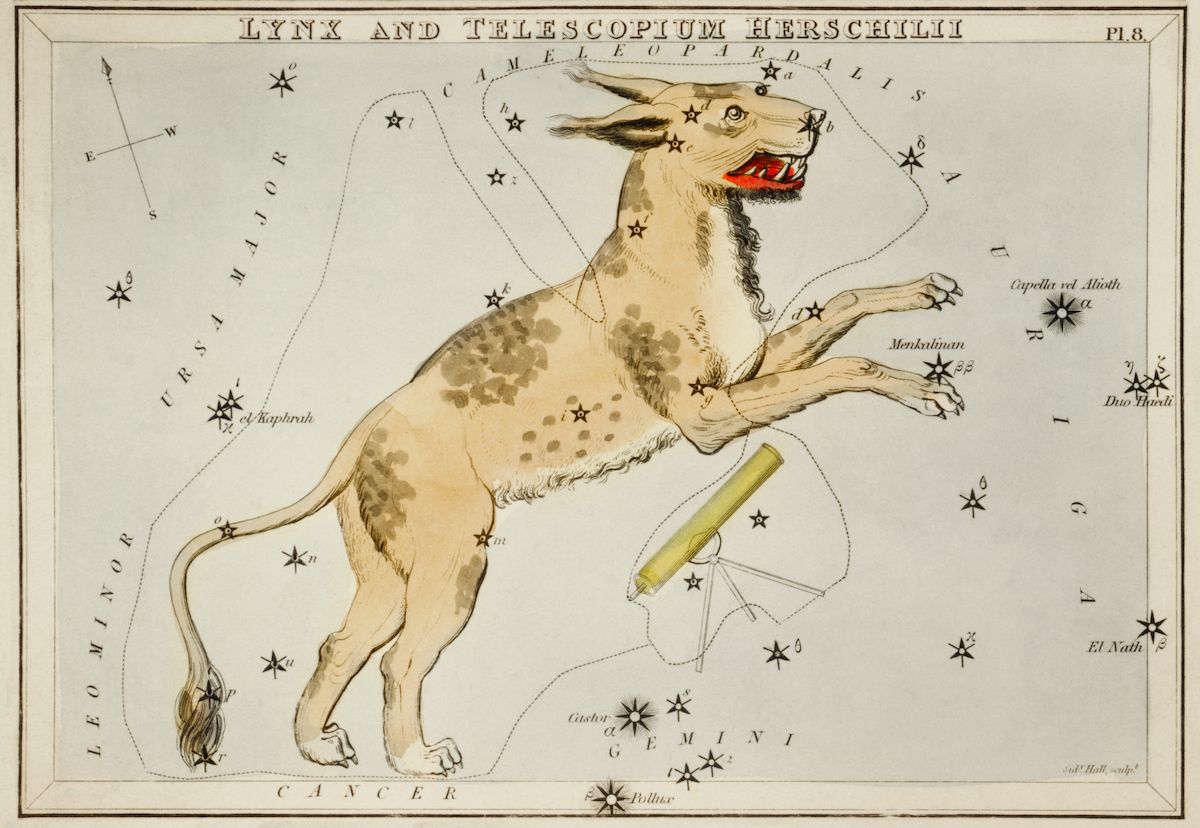
This is an antique celestial map depicting the constellations Lynx and Telescopium Herschelii (also known as the Herschel Telescope). The map is rendered in a vintage style, likely from the 18th or 19th century, with a pale yellow background. The central figure is a large, stylized depiction of the Lynx constellation, represented as a spotted, four-legged animal resembling a large cat or leopard. It's positioned in a dynamic pose, with its front legs raised as if in mid-stride. The animal is intricately detailed with spots covering its body and a somewhat exaggerated facial expression. Superimposed on the Lynx is a depiction of the Telescopium Herschelii, represented as a long, cylindrical telescope. It's positioned diagonally across the Lynx's body, adding a layer of complexity to the image. Numerous stars are scattered across the map, represented by varying sizes of dots. Lines connect these dots to form the constellations. The names of the stars and constellations are written in elegant, cursive script. Around the central figures are the names of neighboring constellations: Ursa Major (the Great Bear) to the left, Cancer below, and Gemini towards the bottom right. A compass rose is visible in the upper left corner, indicating the cardinal directions. The overall aesthetic is that of a scientific illustration, combining astronomical accuracy with artistic flair. The image is likely from a star atlas or a book on astronomy.