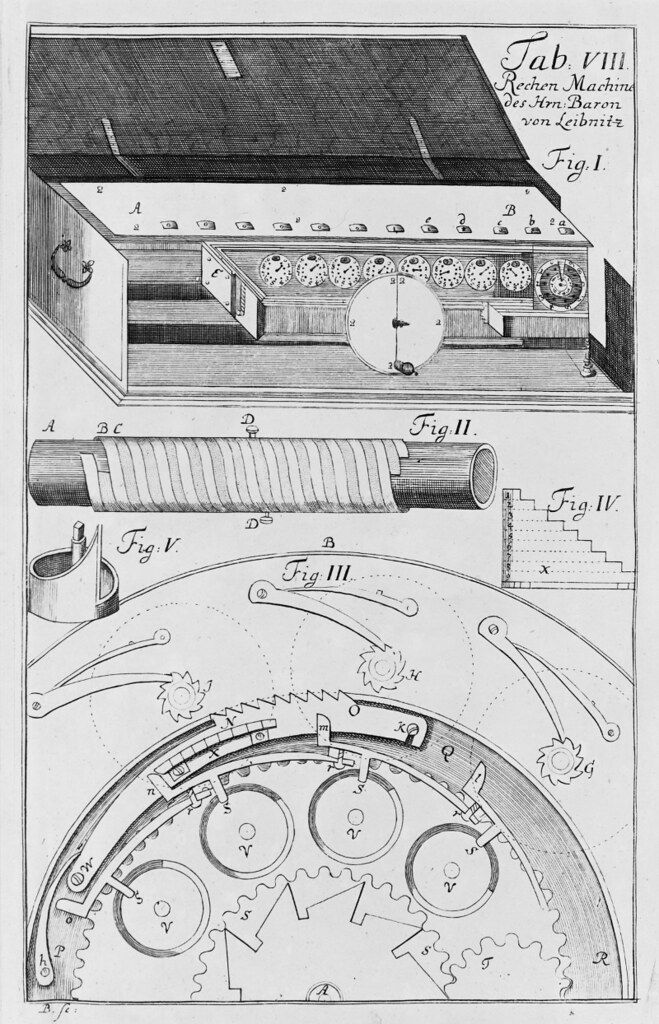
This is a detailed black and white engraving of a mechanical calculating machine, likely Leibniz's calculating machine. The image is a technical illustration with multiple views and labeled components. **Overall Layout:** The image is divided into sections, each depicting a different aspect or component of the machine. The top section (Fig. I) shows a perspective view of the machine's upper part, with several cylindrical gears and levers visible. Below this are several smaller diagrams (Fig. II, III, IV, V) that focus on specific parts and mechanisms. **Key Components:** * **Cylindrical Gears:** Numerous cylindrical gears are depicted, arranged in rows and connected to each other. These gears are the core of the machine's calculation process. * **Levers:** Several levers are visible, likely used to input data or control the gears. * **Cylinders:** There are cylindrical structures that appear to house or support the gears. * **Detailed Mechanisms:** The lower diagrams (Fig. III) show a close-up view of the gear arrangement, with intricate details of the teeth and connections. **Labels and Text:** The image is filled with labels and text, identifying the different parts and mechanisms. The text is in German, and includes the title "Tab. VIII Rechnen Machine Des Hrn: Baron von Leibniz" and figure numbers (Fig. I, II, III, IV, V). **Style and Technique:** The image is an engraving, with fine lines and detailed shading. The style is typical of technical illustrations from the 17th or 18th century. The overall impression is one of complexity and precision, reflecting the intricate nature of the machine. **Overall, this image is a fascinating glimpse into the history of computing, showcasing the ingenuity and craftsmanship of early mechanical calculators.**