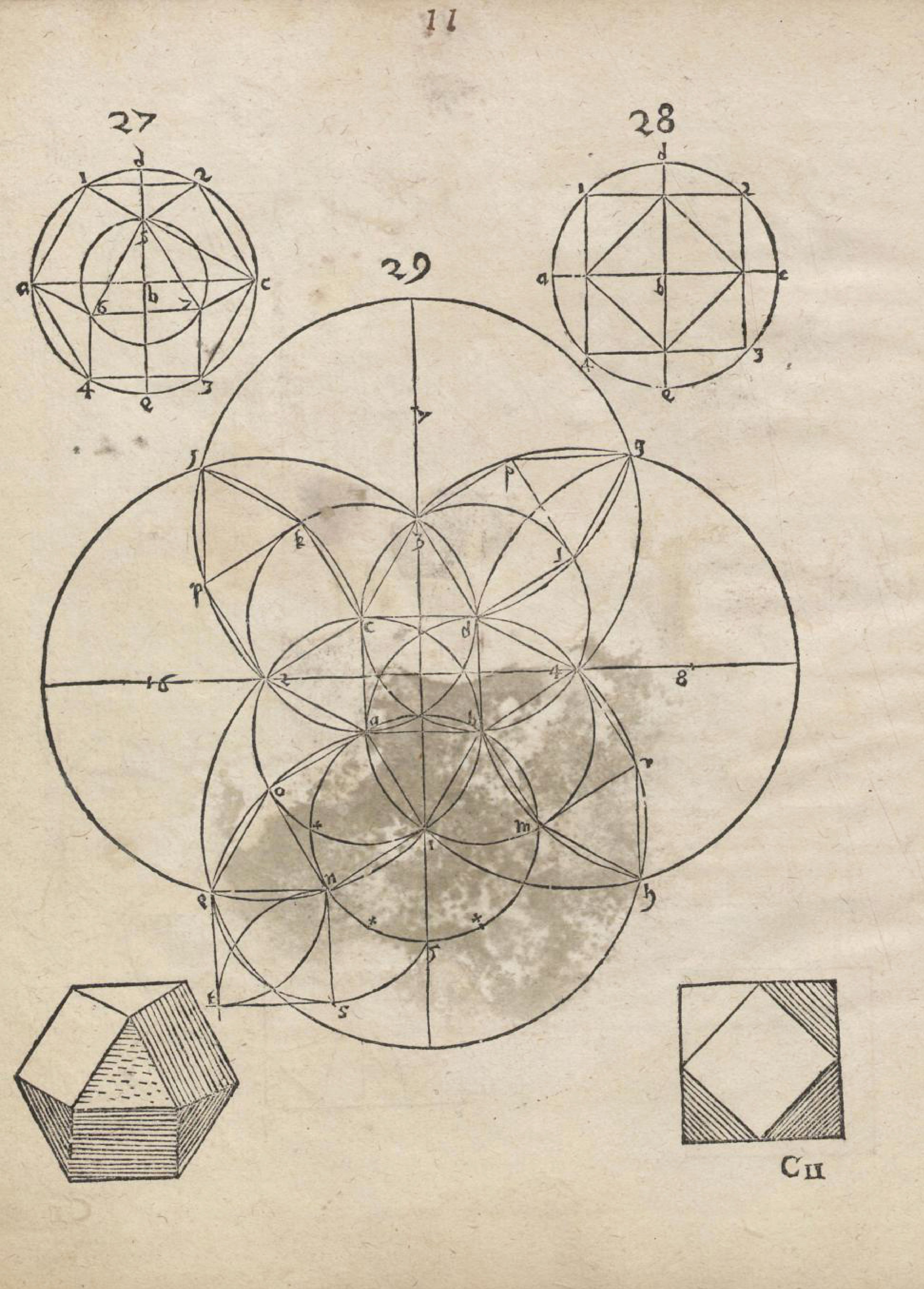
The image is a vintage illustration, likely from a mathematical or philosophical text. It features a complex geometric diagram composed of intersecting circles and polygons. **Central Diagram:** The core of the image is a large, symmetrical design resembling a stylized flower or a vesica piscis. It's constructed from overlapping circles, creating a series of pointed, petal-like shapes. Within this central design, there's a smaller, darker-shaded circular area. Lines and points connect various parts of the diagram, labeled with letters (a, b, c, d, etc.) and numbers (1, 2, 3, etc.). **Smaller Diagrams:** Above the central diagram, there are two smaller, identical diagrams. Each consists of a circle with a polygon inscribed within it. These polygons are labeled with the same letters as the central diagram. **Solid Shapes:** At the bottom left and right corners, there are illustrations of three-dimensional geometric solids. The one on the left appears to be a hexagonal prism, while the one on the right is a square pyramid cut in half. **Text and Numbers:** The image includes numbers (27, 28, 29, 11, and others) and letters used as labels within the diagram. There's also a small 'Cπ' symbol near the bottom right corner. The overall style is reminiscent of Renaissance or early modern scientific illustrations, with precise lines and a focus on geometric relationships. The paper appears aged and has a slightly yellowed tone.