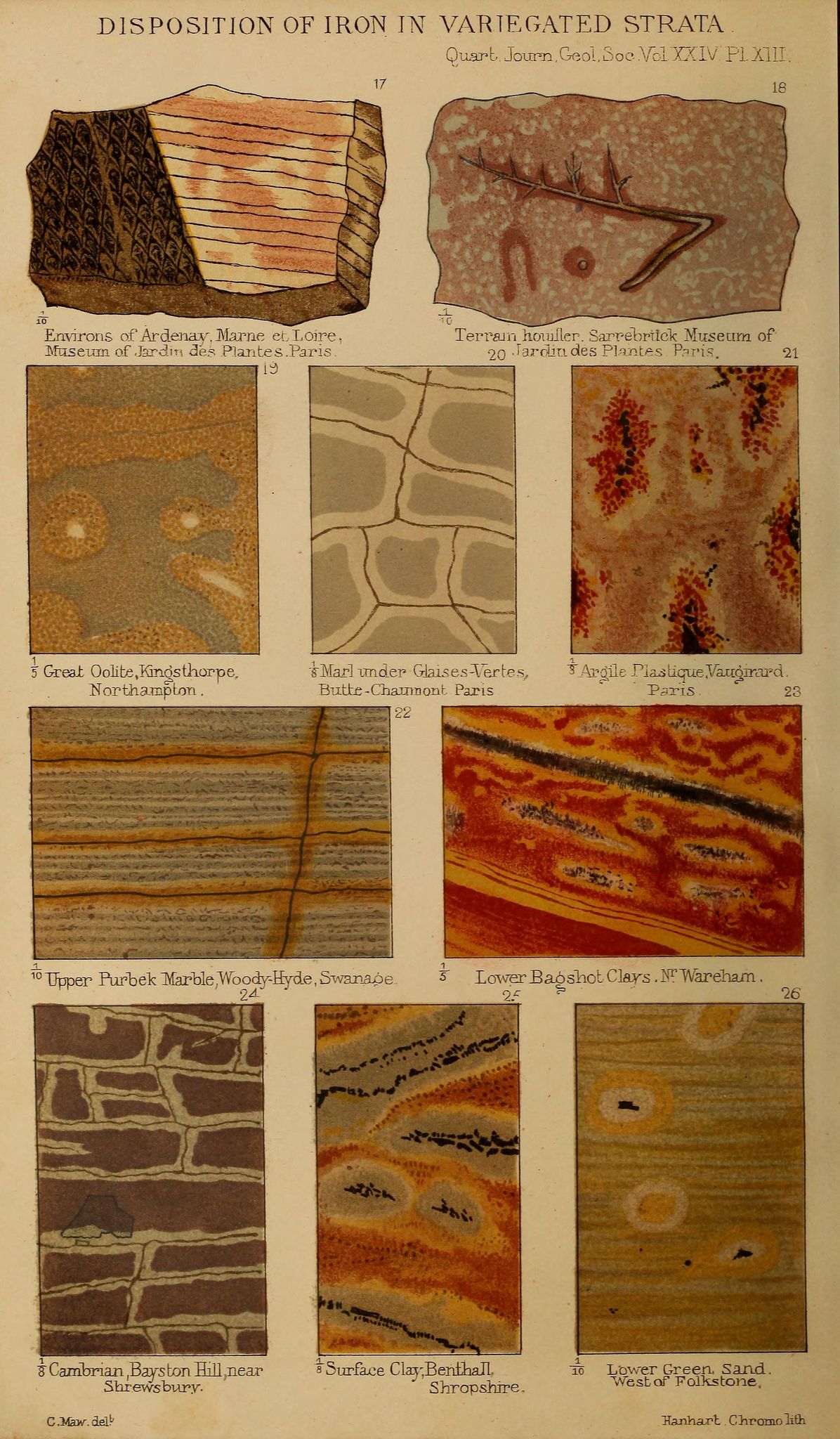
The image is a plate from a geological publication titled "Disposition of Iron in Variegated Strata." It features a grid of 18 square or rectangular samples of various geological formations, each with a number and descriptive label. The samples appear as close-up photographs or illustrations of rock and clay formations, showcasing different textures, colors, and patterns of iron distribution. Here's a breakdown of the samples, moving from top left to bottom right: 1. **17. Environs of Ardenay, Marne et Loire. Museum of Jardin des Plantes, Paris.** - A reddish-brown, layered rock with distinct banding. 2. **18. Terrain Rouiller, Sarrebrück. Museum of Jardin des Plantes, Paris.** - A mottled, reddish-brown and yellowish-brown rock with irregular patterns. 3. **19. Great Oolite, Kingsthorpe, Northampton.** - A light-colored, porous rock with small, dark spots. 4. **20. Marl under Claises Vertes, Butte-Chaumont, Paris.** - A fine-grained, light-colored rock with subtle variations in tone. 5. **21. Argile Plastique, Vaugirard, Paris.** - A reddish-brown clay with a smooth, plastic-like appearance. 6. **22. Upper Purbeck Marble, Woody-Hyde, Swanage.** - A light-colored, layered rock with a marble-like texture. 7. **23. Lower Bagshot Clays, N.F. Wareham.** - A reddish-brown clay with a slightly grainy texture. 8. **24. Cambrian, Bayston Hill, near Shrewsbury.** - A dark, layered rock with a distinct, almost brick-like pattern. 9. **25. Surface Clay, Pentall, Shropshire.** - A reddish-brown clay with a smooth, slightly mottled appearance. 10. **26. Lower Green Sand, West of Folkstone.** - A greenish-brown sandstone with a grainy texture. The overall color palette is dominated by shades of brown, red, green, and gray, reflecting the iron content and mineral composition of the samples. The plate is a scientific illustration intended to document and compare the appearance of iron-bearing rocks and clays from different locations.