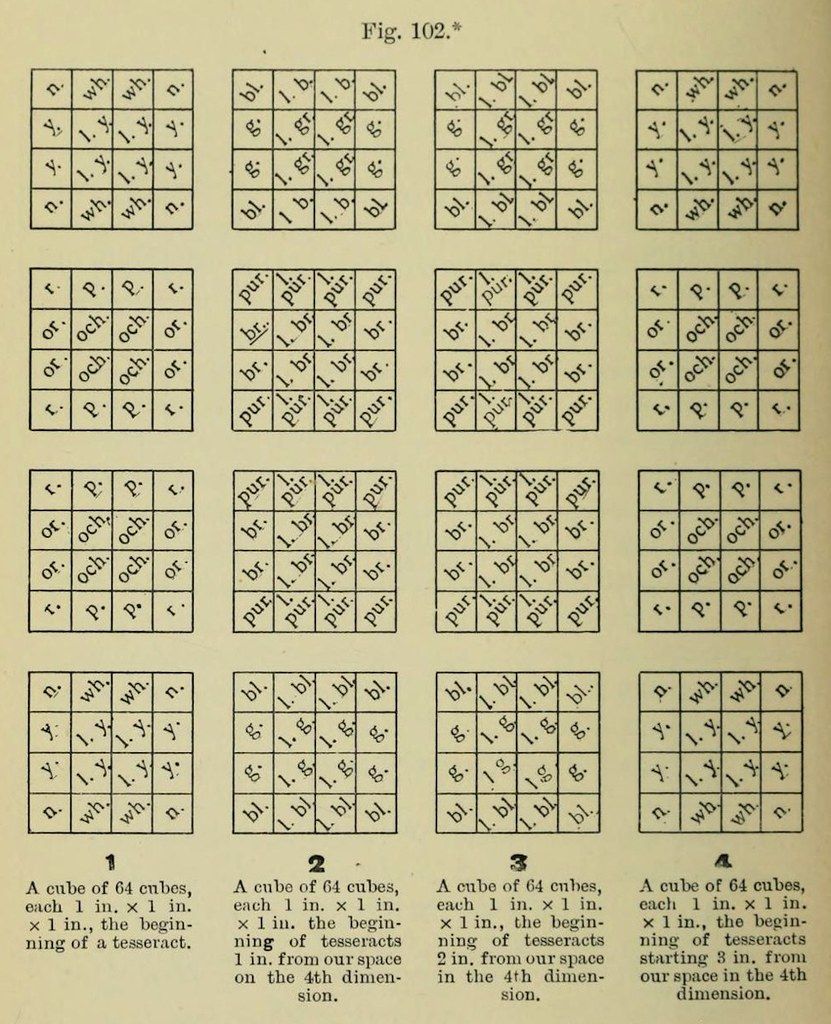
The image shows a diagram titled "Fig. 102.". It depicts four progressively more complex cubes, each built from 64 smaller cubes. Each small cube is labeled with a two-letter abbreviation. The cubes are arranged in a row, and each is described with the following text: "A cube of 64 cubes, each 1 in. x 1 in. x 1 in., the beginning of a tessaract in our space on the 4th dimension." Here's a breakdown of the visual elements: * **Arrangement:** Four cubes are displayed side-by-side, each representing a stage in the construction of a tesseract (a four-dimensional hypercube). * **Cube Structure:** Each large cube is composed of 64 smaller cubes arranged in a 4x4x4 grid. * **Labeling:** Each small cube is labeled with a two-letter abbreviation (e.g., "wh", "bl", "pur", "och", etc.). The labels appear to be consistent within each cube, but change between cubes. * **Text:** The title "Fig. 102." is at the top of the image. Below each cube is a description of its dimensions and its role in the construction of a tesseract. The overall impression is a geometric illustration of a complex mathematical concept (the tesseract) visualized through a series of progressively more complex cubes.