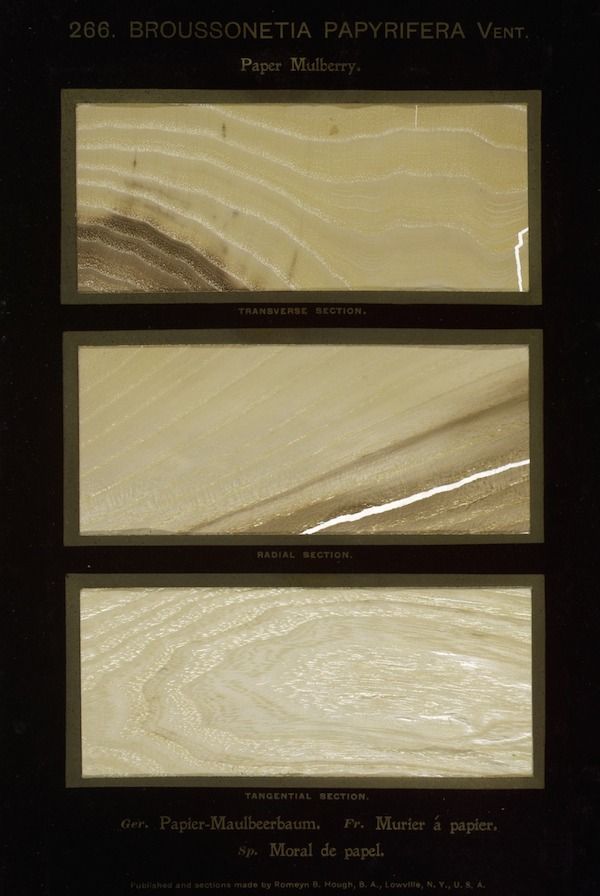
The image is a vintage botanical illustration featuring microscopic sections of a plant called Broussonetia papyrifera, commonly known as Paper Mulberry. It's presented as a vertical arrangement of three rectangular images, each labeled with the type of section displayed. **Top Image:** Labeled "TRANSVERSE SECTION," it shows a close-up view of the plant's tissue cut across its width. The tissue appears as a network of elongated cells, with varying shades of brown and beige. There's a clear distinction between the outer and inner layers, and some cells are more densely packed than others. **Middle Image:** Labeled "RADIAL SECTION," this image displays a view of the plant's tissue cut along its radius. The cells are arranged in a more linear fashion, with a radial pattern emanating from the center. The colors are similar to the top image, with shades of brown and beige. **Bottom Image:** Labeled "TANGENTIAL SECTION," this image shows a view of the plant's tissue cut tangentially. The cells are arranged in a more irregular pattern, with a mix of elongated and rounded shapes. The colors are similar to the other two images, with shades of brown and beige. Below the images, there's text in multiple languages: "Ger. Papier-Maulbeerbaum." (German), "Fr. Murier à papier." (French), and "Sp. Moral de papel." (Spanish). These are the common names for the Paper Mulberry in those languages. The image has a vintage, sepia-toned appearance, suggesting it's an older botanical illustration. The background is a dark, almost black color, which makes the sections stand out. The overall impression is one of scientific detail and botanical accuracy.