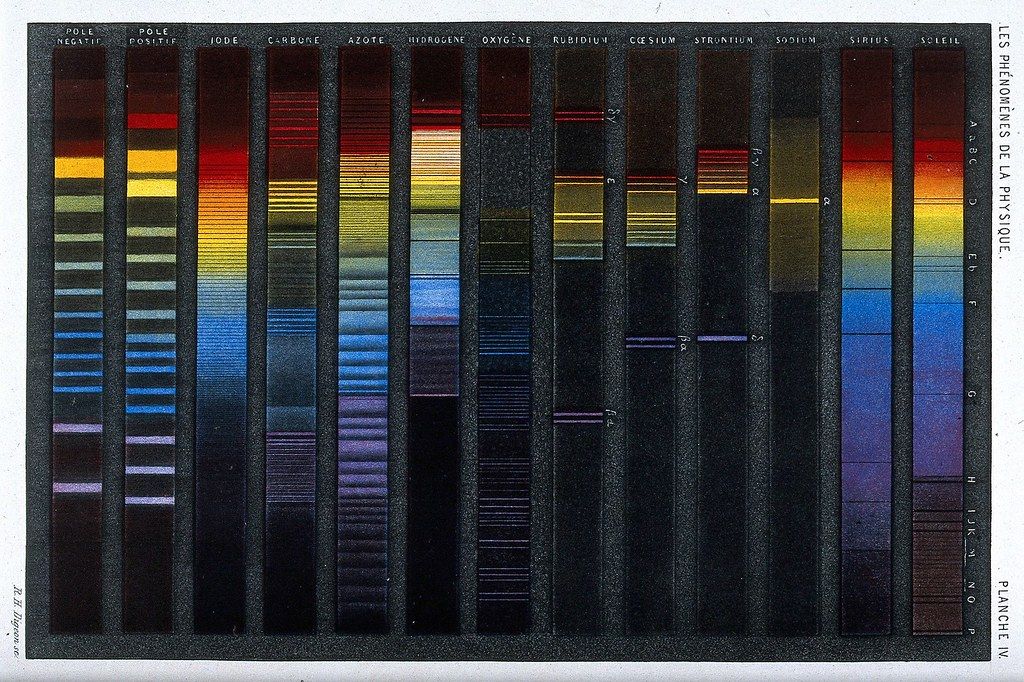
This is a vintage scientific diagram, likely from a physics or chemistry textbook. It depicts a series of spectral lines for various elements, arranged in vertical columns. The diagram is titled 'LES PHÉNOMÈNES DE LA PHYSIQUE. PLANCHE IV.' at the right edge. Below that is a series of letters (A, B, C, etc.) running down the side. Each column represents a different element, labeled in French: 'Pole Négatif', 'Pole Positif', 'Iode', 'Carbone', 'Azote', 'Hydrogène', 'Oxygène', 'Rubidium', 'Césium', 'Strontium', 'Sodium', 'Sirius', 'Scille'. Within each column, there are numerous horizontal lines of varying colors and thicknesses. These lines represent the specific wavelengths of light emitted or absorbed by each element. The colors range from deep blues and purples to greens, yellows, oranges, and reds. Some lines are bright and distinct, while others are fainter and more diffuse. The background of the diagram is a dark, almost black, shade, which helps to emphasize the colorful spectral lines. The overall aesthetic is reminiscent of early scientific illustrations, with a focus on precise observation and documentation.