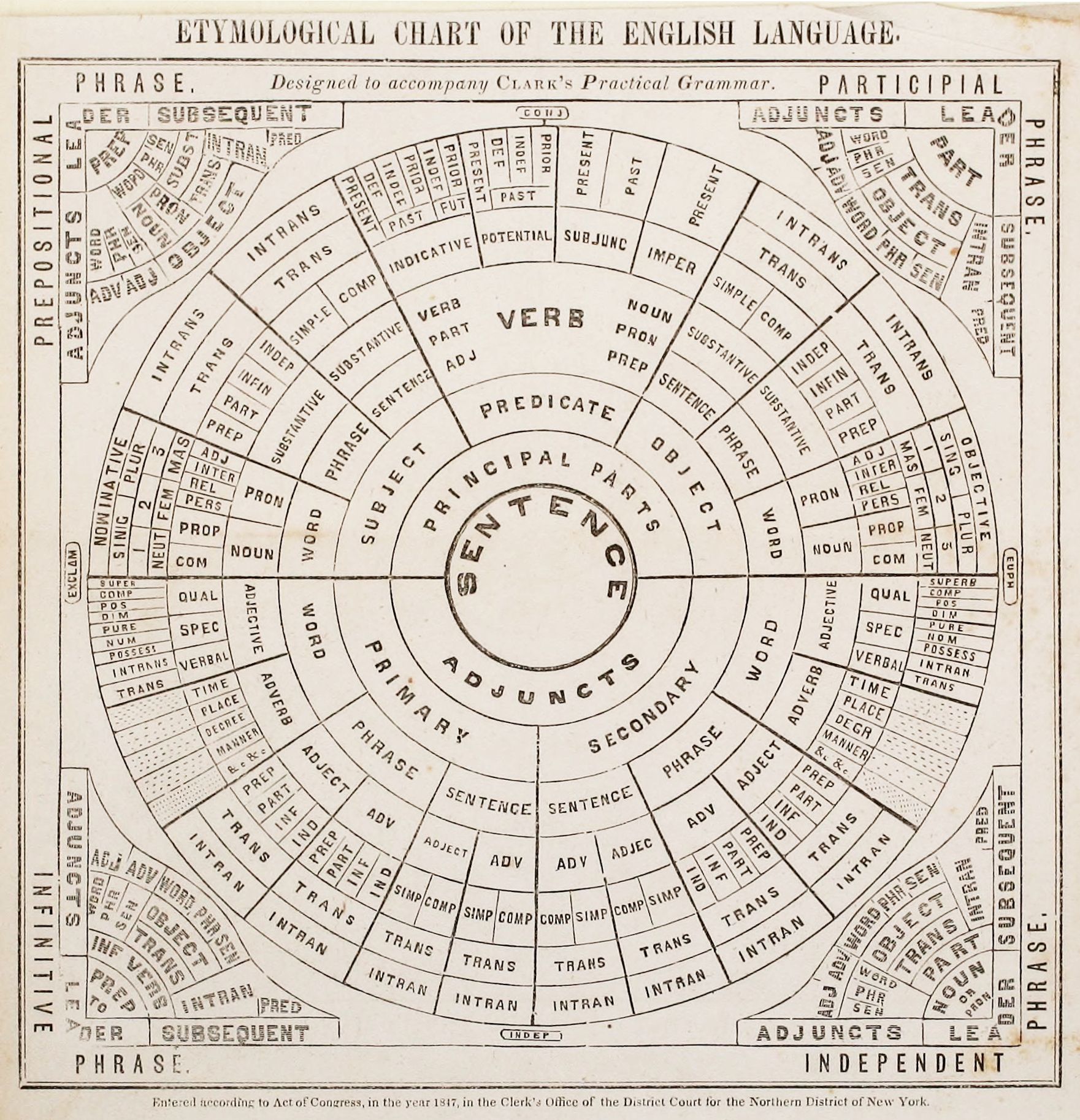
The image is a detailed, circular chart titled "ETYMOLOGICAL CHART OF THE ENGLISH LANGUAGE." It's designed to accompany Clark's Practical Grammar. The chart is a complex diagram with concentric circles and radiating lines, filled with grammatical terms and abbreviations. **Central Focus:** The very center of the chart reads "PRINCIPAL PARTS OF SENTENCE" in a bold, stylized font. Around this are the words "PRIMARY" and "SECONDARY" in smaller fonts. **Concentric Circles:** The chart is organized into concentric circles, each representing a different grammatical category. These include: * **Outer Ring:** Labeled "ADJUNCTS" and "PARTICIPIAL." It contains terms like "PRESENT," "PAST," "INFINITIVE," and various abbreviations. * **Middle Rings:** These rings are filled with terms like "VERB," "NOUN," "ADJECTIVE," "ADVERB," "PRON," "PREP," and abbreviations like "COMP," "SIMP," "INTRA," and "TRAN." * **Inner Rings:** These rings contain more specific grammatical terms and abbreviations, organized around the central focus. **Radiating Lines:** Lines radiate from the center, connecting the central terms to the outer rings, creating a web-like structure. **Text and Abbreviations:** The chart is densely packed with text, including grammatical terms, abbreviations, and labels. The abbreviations seem to represent different tenses, forms, and categories of words. **Overall Impression:** The chart is a complex and detailed visual aid for understanding the structure of the English language. It's a historical artifact, likely from a 19th or early 20th-century grammar textbook. The style is reminiscent of Victorian-era diagrams and charts, with a focus on categorization and visual organization.