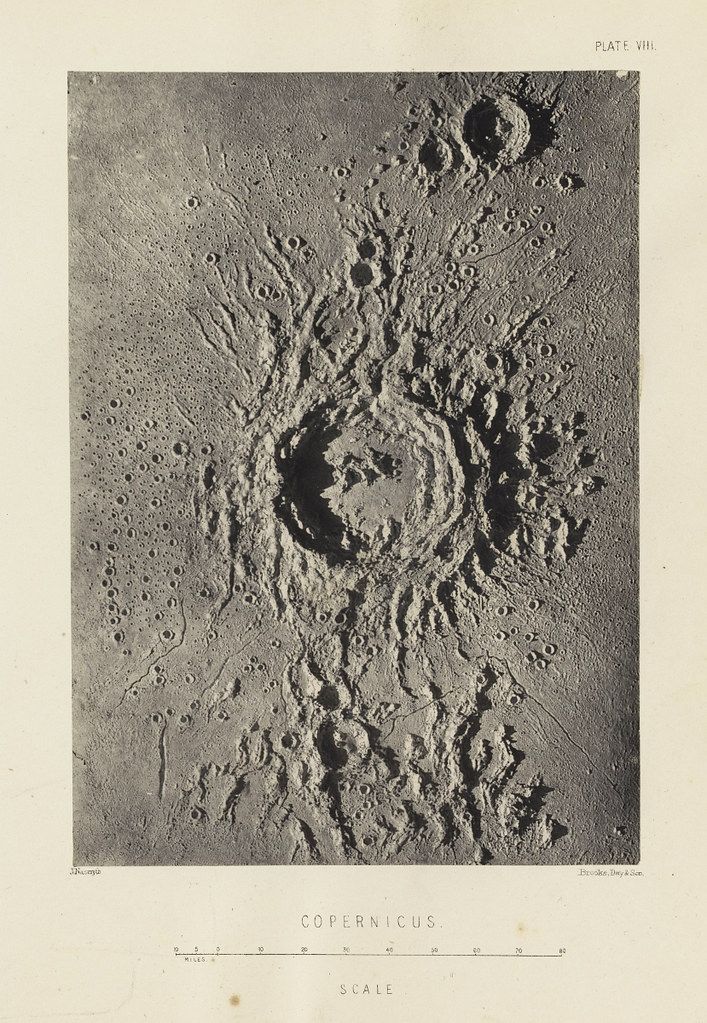
This is a vintage, black and white illustration of the lunar crater Copernicus, as seen from above. The crater dominates the image, appearing as a large, circular depression on the moon's surface. It's characterized by a central peak and terraced walls. The crater's interior is complex, with a network of ridges, hills, and what appear to be small mountains. Bright areas within the crater suggest elevated terrain catching the sunlight. Darker areas indicate shadows, emphasizing the three-dimensional nature of the lunar landscape. Radiating outwards from the crater are bright streaks, known as rays, which are likely ejecta from the impact that formed the crater. These rays extend across the surrounding lunar surface, becoming fainter with distance. The surrounding terrain is heavily cratered, with numerous smaller craters scattered across the landscape. At the bottom of the image, there's a scale indicating distances in kilometers. The illustration is labeled 'COPERNICUS' and 'PLATE VIII' at the top. The style is reminiscent of early 20th-century astronomical illustrations, with a focus on detail and shading to convey the texture of the lunar surface.