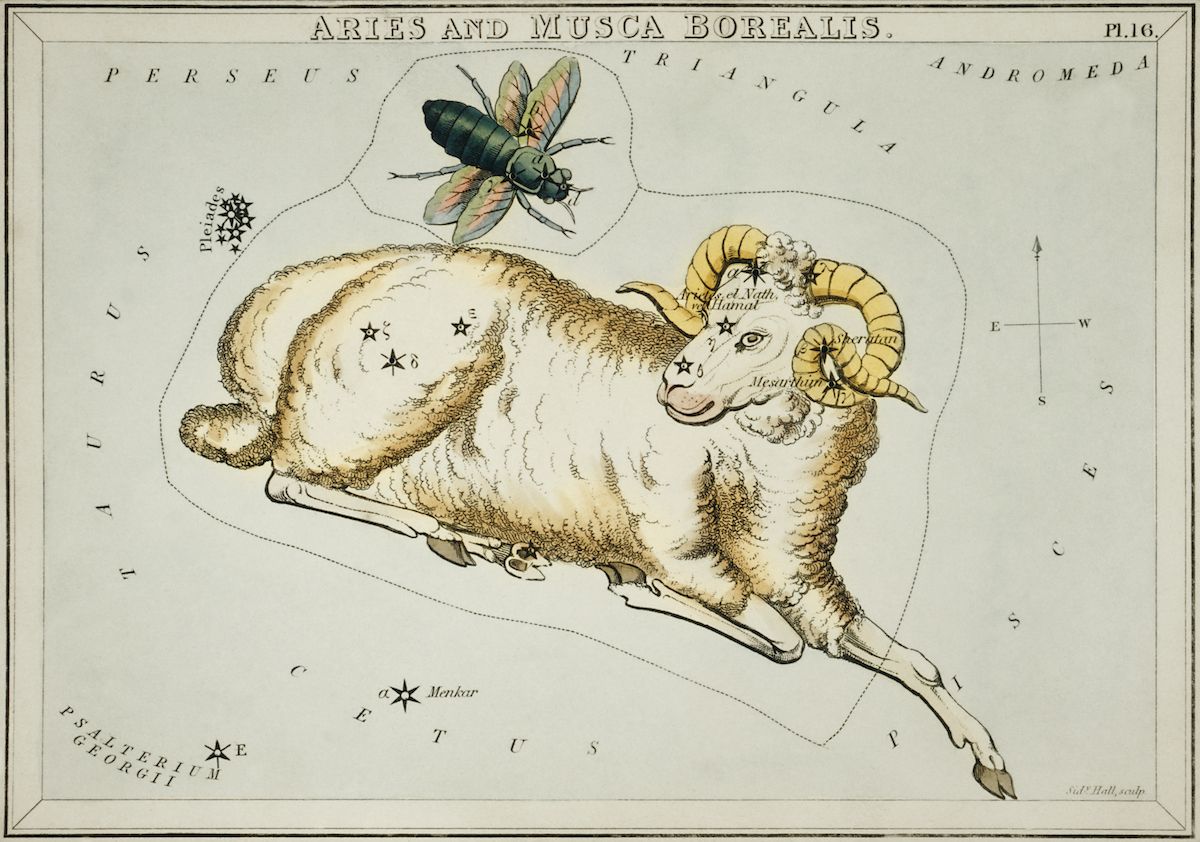
This is a vintage astronomical illustration titled "Aries and Musca Borealis," plate 16. The central image is a detailed depiction of a ram, rendered in a style reminiscent of 18th or 19th-century scientific illustration. The ram is a light brown color, with a fluffy, textured coat. It's depicted in a dynamic pose, appearing to leap or run. Its large, curved horns are a prominent feature. Above the ram, a large, detailed fly (Musca Borealis) is illustrated. It has iridescent wings with intricate patterns. Scattered across the image are numerous stars, represented by varying sizes of starbursts. These stars are connected by faint lines, forming the constellation Aries. The names of prominent stars within the constellation are labeled in elegant script, such as "Hamal" and "Sheratan". Around the central image are the names of neighboring constellations: Perseus, Triangulum, and Andromeda, written in capital letters. A compass rose with the letters N, S, E, and W is also present, indicating direction. The background is a pale, creamy color. The illustration is framed by a thin, dark border. The style is highly detailed and precise, typical of historical astronomical charts. The signature "W.B. Bardwell" is visible in the lower right corner.