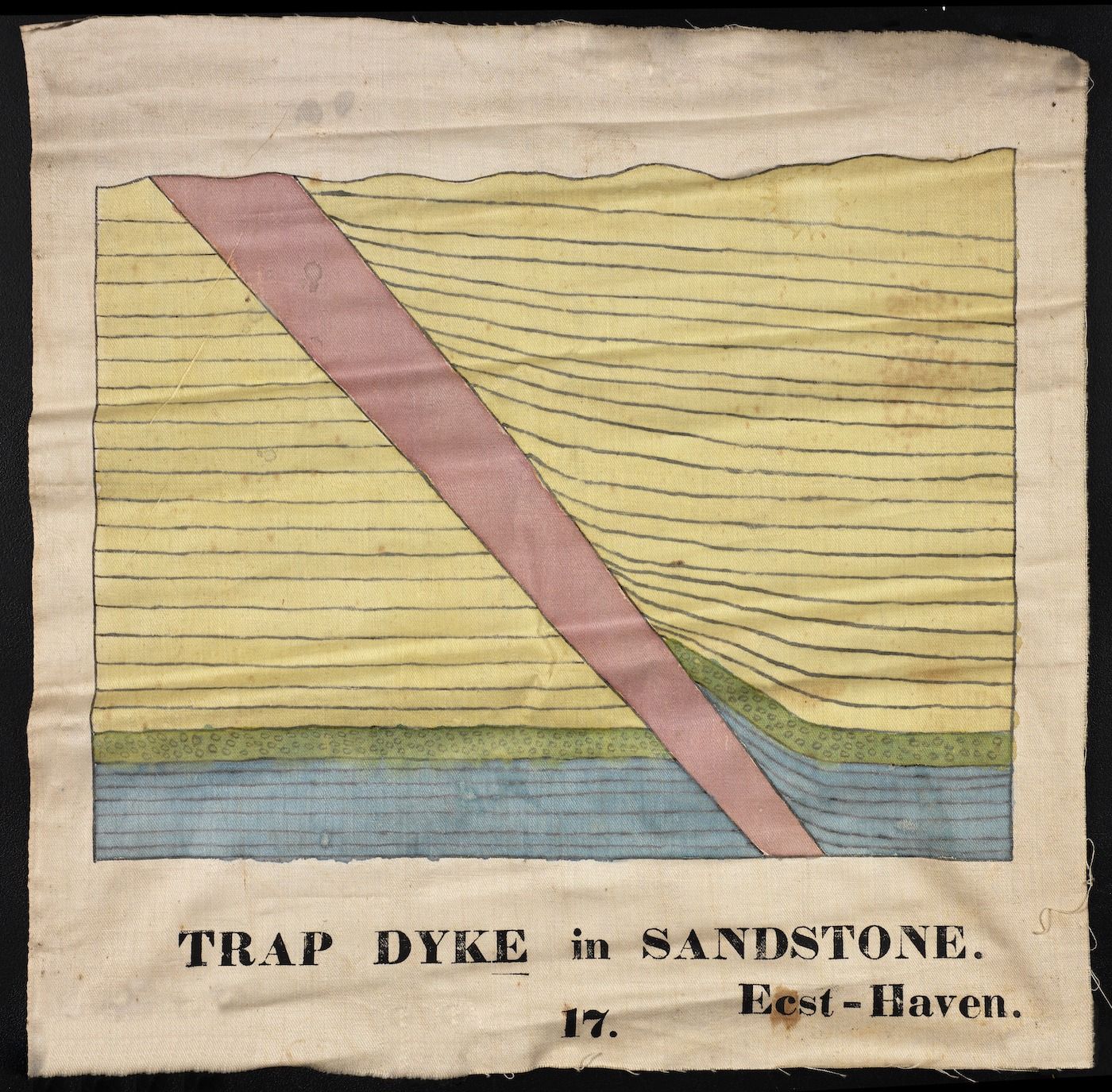
The image is a hand-drawn geological diagram, likely from the 19th century, depicting a 'Trap Dyke in Sandstone'. The majority of the image is filled with horizontal lines representing layers of sandstone, colored in a pale yellow. These layers are intersected by a diagonal, pink-colored formation labeled as the 'Trap Dyke'. The dyke cuts through the sandstone layers, appearing as a solid, elongated shape. Below the sandstone layers, there's a section of blue, representing a water body or a different geological layer. The bottom of the blue section is slightly wavy, suggesting a shoreline or uneven surface. At the bottom of the image, there's text in a bold, black font. It reads 'TRAP DYKE in SANDSTONE.' Below that, '17. Ecst-Haven.' is written. The paper has a slightly aged and worn appearance, with some discoloration and creases. The style of the drawing is illustrative and schematic, typical of geological diagrams from that era. It's meant to convey the relationship between the dyke and the surrounding sandstone layers rather than a realistic depiction of the landscape.