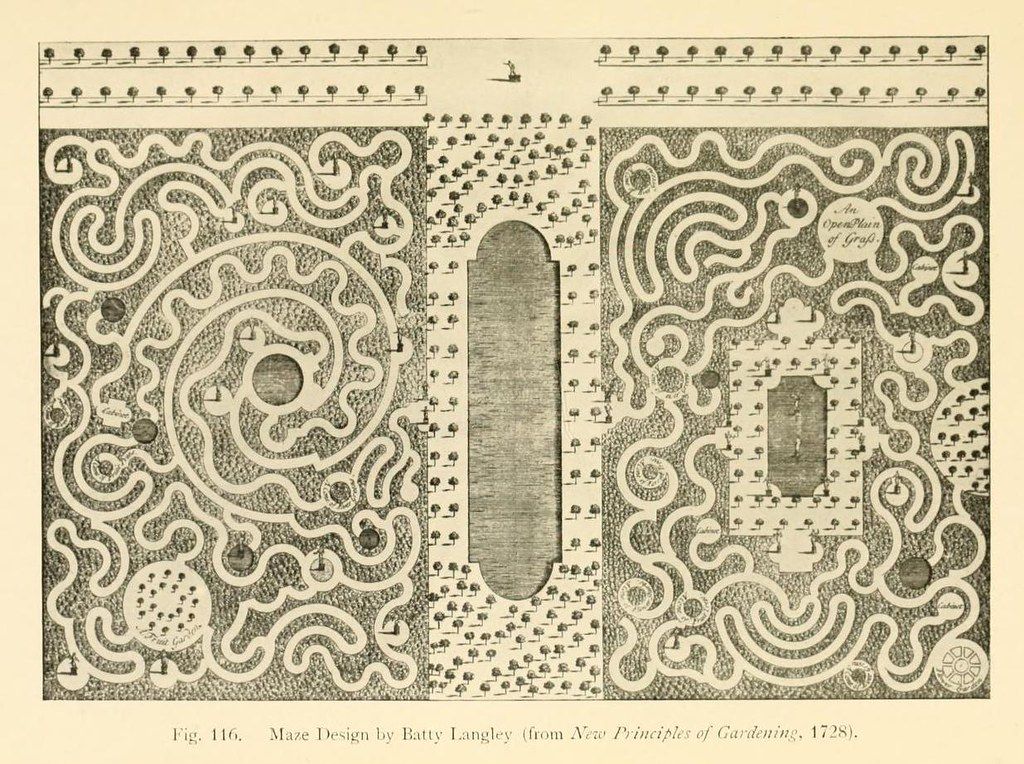
The image is a detailed, antique-style illustration of a maze design, labeled as 'Maze Design by Batty Langley' from 'New Principles of Gardening, 1728'. It's a top-down view of a complex, swirling maze with a central rectangular open area. The maze walls are depicted as curving lines, creating a dense network of pathways. Here's a breakdown of the details: * **Maze Layout:** The maze is divided into two main sections, separated by a central rectangular space. Each section features intricate, swirling patterns of pathways. The pathways are not uniform; they vary in width and curvature, adding to the complexity. * **Central Space:** The central rectangular area is open and appears to be a viewing or gathering space within the maze. It's surrounded by the maze walls on all sides. * **Entrance/Exit:** There are multiple entrances and exits to the maze, indicated by small rectangular openings along the perimeter. These openings are evenly spaced around the maze's edges. * **Details:** The maze walls are not solid lines but are composed of small dots, giving the impression of hedges or low walls. There are also small square or rectangular features within the maze, possibly representing fountains, statues, or other garden elements. * **Style:** The illustration is done in a detailed, engraved style, typical of 18th-century garden designs. The lines are precise and the shading is minimal, emphasizing the geometric patterns of the maze. * **Border:** The top of the image has a row of small circles or dots, possibly representing a border or decorative element. The overall impression is of a meticulously planned and elaborate garden maze, designed for both visual appeal and challenging navigation.