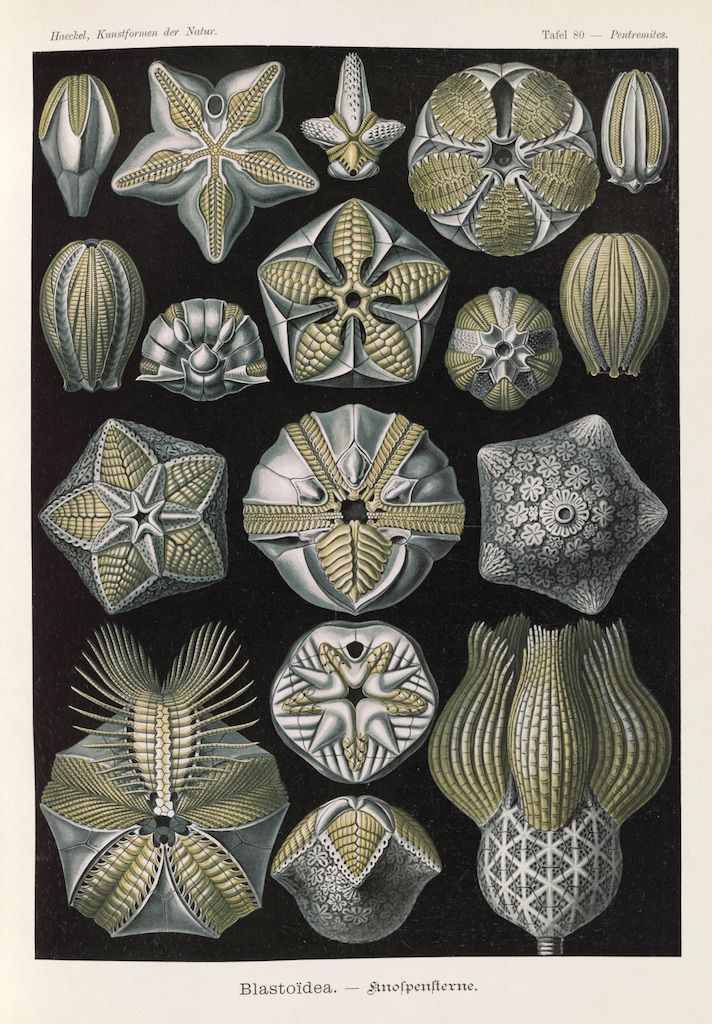
This is a vintage biological illustration, likely from a scientific publication. It's a plate (labeled 'Tafel 80') showcasing various species of Blastoidea, also known as 'Jurapfensterne' (German for 'Jurassic sea stars'). The plate is densely packed with detailed drawings of these marine invertebrates. They are radially symmetrical, resembling a combination of sea urchins and starfish. Each specimen is unique in its shape and ornamentation. Here's a breakdown of the visual elements: * **Arrangement:** The illustrations are arranged in a grid-like pattern, maximizing the number of specimens displayed on the plate. * **Style:** The illustrations are highly detailed and precise, typical of scientific illustrations. They emphasize the structural features of the organisms. * **Color Palette:** The illustrations are primarily in shades of brown, yellow, and white, with some darker shading to create depth and highlight the textures. * **Details:** The illustrations show intricate patterns, ridges, and spines on the surfaces of the organisms. Some specimens have petal-like or star-shaped structures. * **Labels:** The plate includes German text at the top and bottom, identifying the artist (Haeckel) and the subject matter (Blastoidea). The overall impression is one of scientific accuracy and artistic skill. The plate is a beautiful example of early biological illustration, showcasing the diversity of marine life from the Jurassic period.