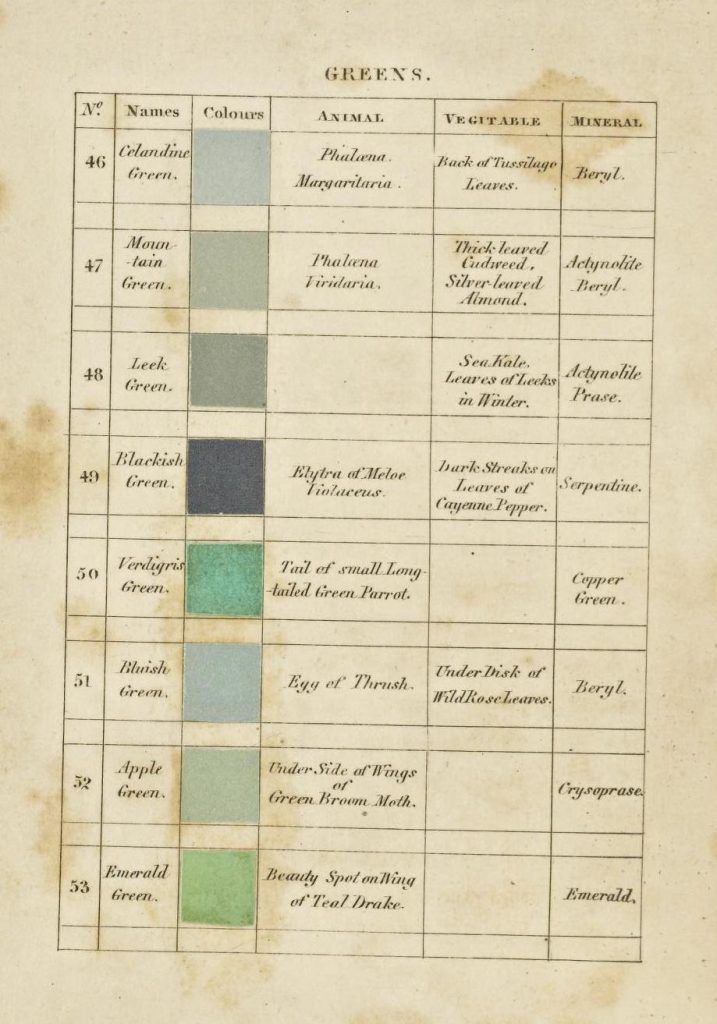
The image is a vintage chart titled "GREENS". It's a table with columns labeled "No", "Names", "Colours", "ANIMAL", "VEGETABLE", and "MINERAL". Each row represents a different shade of green, numbered from 46 to 53. Each row includes a color swatch, the name of the green shade, and examples of where that shade can be found in the animal, vegetable, and mineral kingdoms. Here's a breakdown of the rows: * **46: Celandine Green** - Color swatch is a pale yellow-green. Animal: *Phalena Margitaria*. Vegetable: Back of Tussilage Leaves. Mineral: Beryl. * **47: Mossy-tain Green** - Color swatch is a muted, olive green. Animal: *Phalena Viridaria*. Vegetable: Dark-leaved Cudweed, Silver-leaved Almond. Mineral: Actinolite Beryl. * **48: Leek Green** - Color swatch is a light, slightly grayish green. Animal: N/A. Vegetable: Sea Kale, Leaves of Leeks in Winter. Mineral: Actinolite Prase. * **49: Blackish Green** - Color swatch is a dark, muted green. Animal: *Elytra of Meloe Violaceus*. Vegetable: Dark Streaks on Leaves of Cayenne Pepper. Mineral: Serpentine. * **50: Verdigris Green** - Color swatch is a bright, slightly bluish green. Animal: Tail of small Long-tailed Green Parrot. Vegetable: N/A. Mineral: Copper Green. * **51: Bluish Green** - Color swatch is a muted, grayish-blue-green. Animal: Egg of Thrush. Vegetable: Under-bisk of Wild Rose Leaves. Mineral: Beryl. * **52: Apple Green** - Color swatch is a bright, yellowish-green. Animal: Under Side of Wings of Green Brown Moth. Vegetable: N/A. Mineral: Chrysoprase. * **53: Emerald Green** - Color swatch is a rich, vibrant green. Animal: Beauty Spot on Wing of Teal Drake. Vegetable: N/A. Mineral: Emerald. The chart has a slightly aged appearance, with a sepia tone and visible texture. The text is handwritten in a delicate script. The overall impression is that of a scientific or artistic document from the 19th or early 20th century.