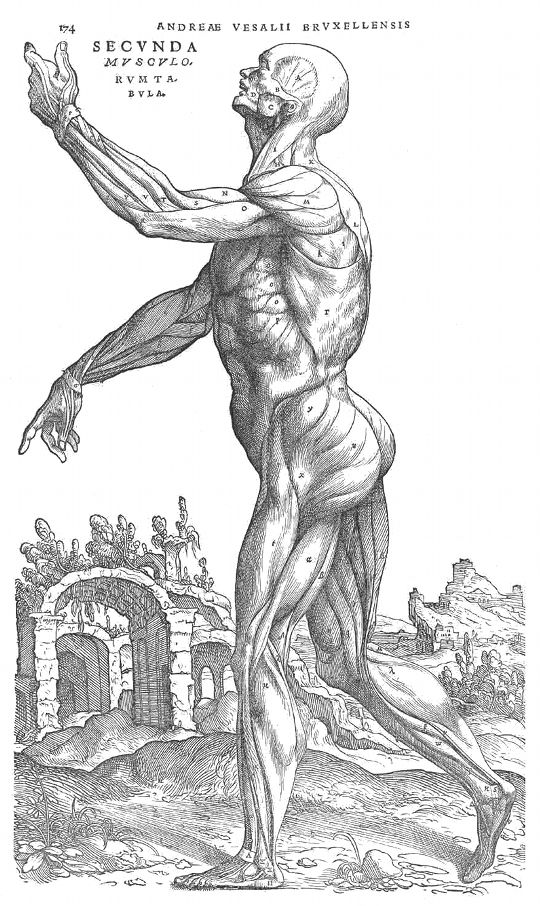
This is a detailed woodcut illustration from a 16th-century anatomical text, likely by Andreas Vesalius. It depicts a male figure in a classical contrapposto pose, showcasing the musculature of the body. The figure is stripped of skin, revealing a highly detailed rendering of muscles, tendons, and bones. The muscles are shaded with fine lines to create a sense of depth and volume. The figure's right arm is raised and extended, while the left arm is bent at the elbow. The legs are positioned in a dynamic stance, with one leg forward and the other back. The background features a landscape with architectural ruins, including arches and crumbling structures. Small figures are visible in the distance, adding a sense of scale and context. The overall style is reminiscent of Renaissance art, with a focus on anatomical accuracy and classical aesthetics. At the top of the image, there is text in Latin, likely identifying the author and the subject of the illustration. The image is rendered in black and white, with a high level of detail and precision.