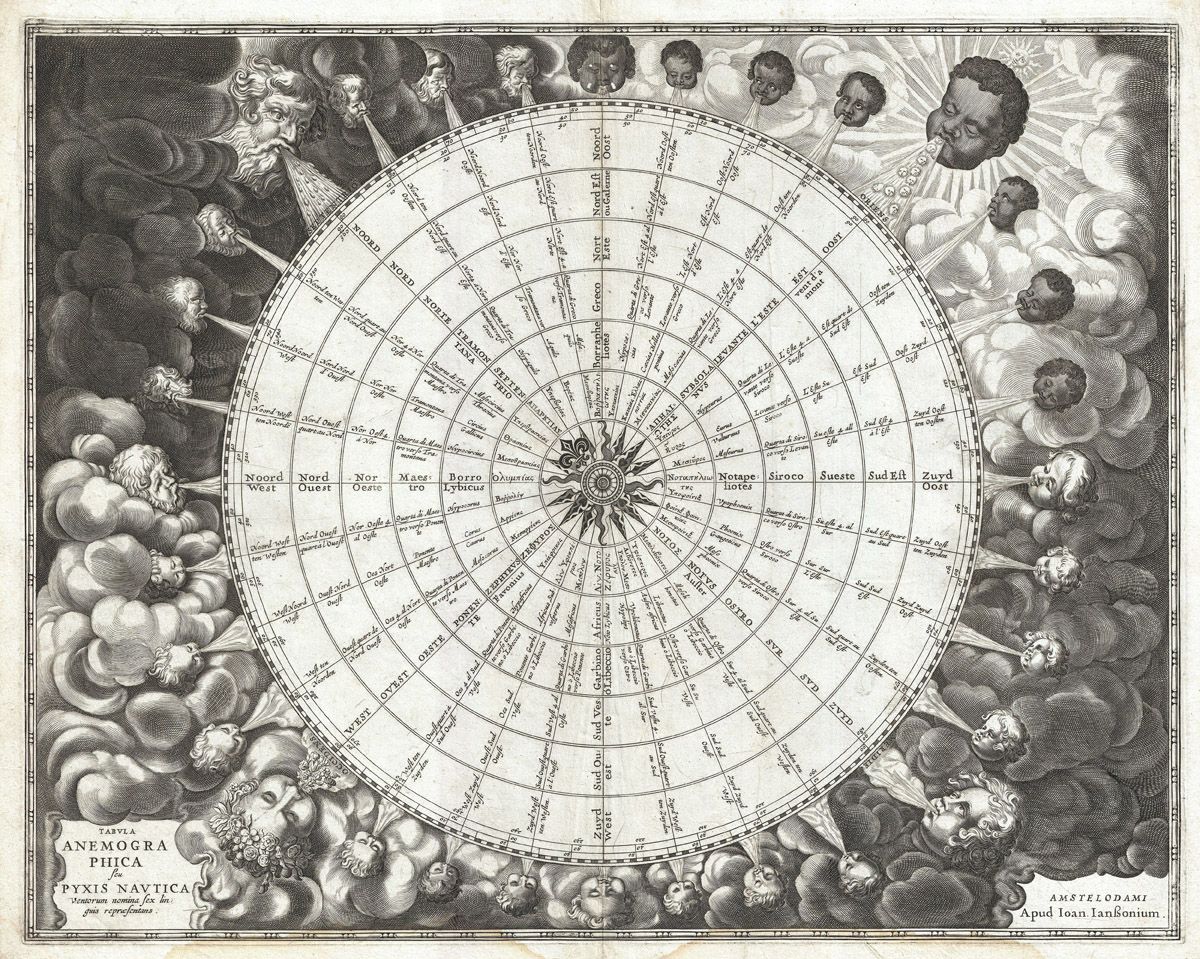
This is a detailed engraving of a wind rose or compass rose, a nautical chart used for determining wind direction. The central point of the rose is a small circle with Latin text. Radiating outwards are 32 sections, each representing a different wind direction, labeled in Dutch, Latin, and possibly other languages. The directions are arranged in a circular pattern, with the cardinal directions (North, East, South, West) prominently displayed. The outer edges of the rose are adorned with elaborate decorative elements. There are depictions of clouds and numerous cherubic angels, each with wings and flowing robes, arranged around the circumference. The angels appear to be blowing wind, contributing to the thematic representation of wind direction. The overall design is highly detailed and intricate, typical of historical nautical charts. The engraving is executed in a fine line style, with shading and cross-hatching used to create depth and texture. At the bottom right corner, there is text that reads “Amstelodami Apud Ioan Iansonium”, indicating the place of publication (Amsterdam) and the publisher (Jan Jansonius). At the bottom left corner, there is text that reads “Tabula Anemographica Pyxis Nautica”, which is the title of the chart. The image is a beautiful example of early cartographic art, combining practical navigational information with elaborate decorative elements.