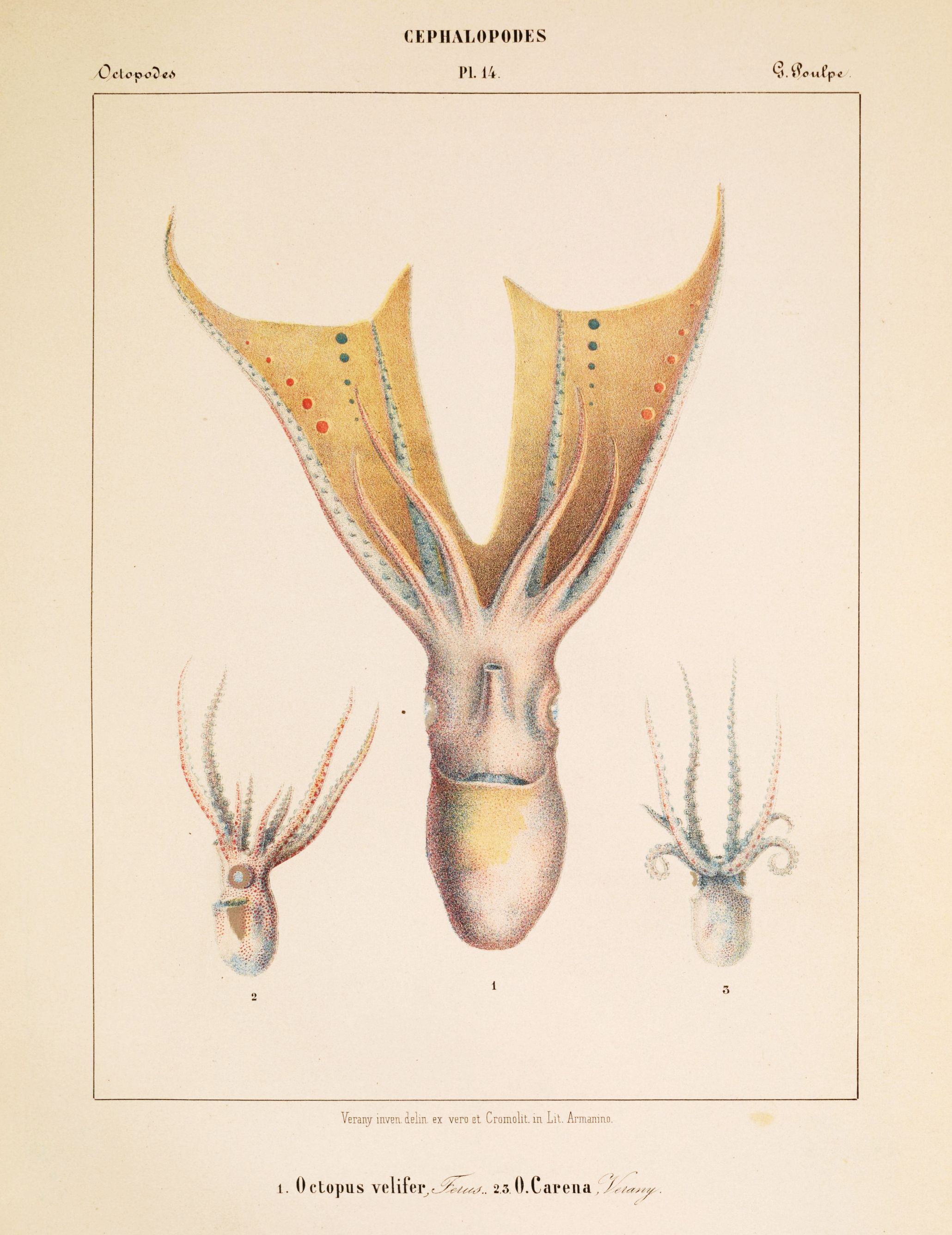
The image is a vintage scientific illustration of octopuses, likely from a zoological or marine biology publication. It's a plate labeled 'Cephalopodes, Pl. 14' and signed 'G. Boulpe'. The background is a pale yellow, reminiscent of aged paper. There are three distinct octopus depictions: 1. **Central Octopus:** This is the largest and most detailed. It's presented in a full-body view, with a bulbous, elongated body. The most striking feature is the elaborate fringe of numerous, thin, vertical filaments extending along the sides of its body, resembling a feathered cloak. The color is a mix of pinkish-purple and pale yellow, with subtle shading. The tentacles are long and slender, with small suckers visible. 2. **Left Octopus:** A smaller, more simplified depiction of an octopus. It's a side view, showing a rounded body and short tentacles. The color is a muted brown. 3. **Right Octopus:** Similar to the left one, but slightly more elongated. It's also a side view, with a brown hue. Below the illustrations, there's text in a delicate script, identifying the species: '1. Octopus velifer. Tab. 23. 0. Carena'. The style of the illustration is characteristic of 19th-century scientific drawings, emphasizing accuracy and detail. The use of watercolor or similar media gives the image a soft, slightly faded appearance.