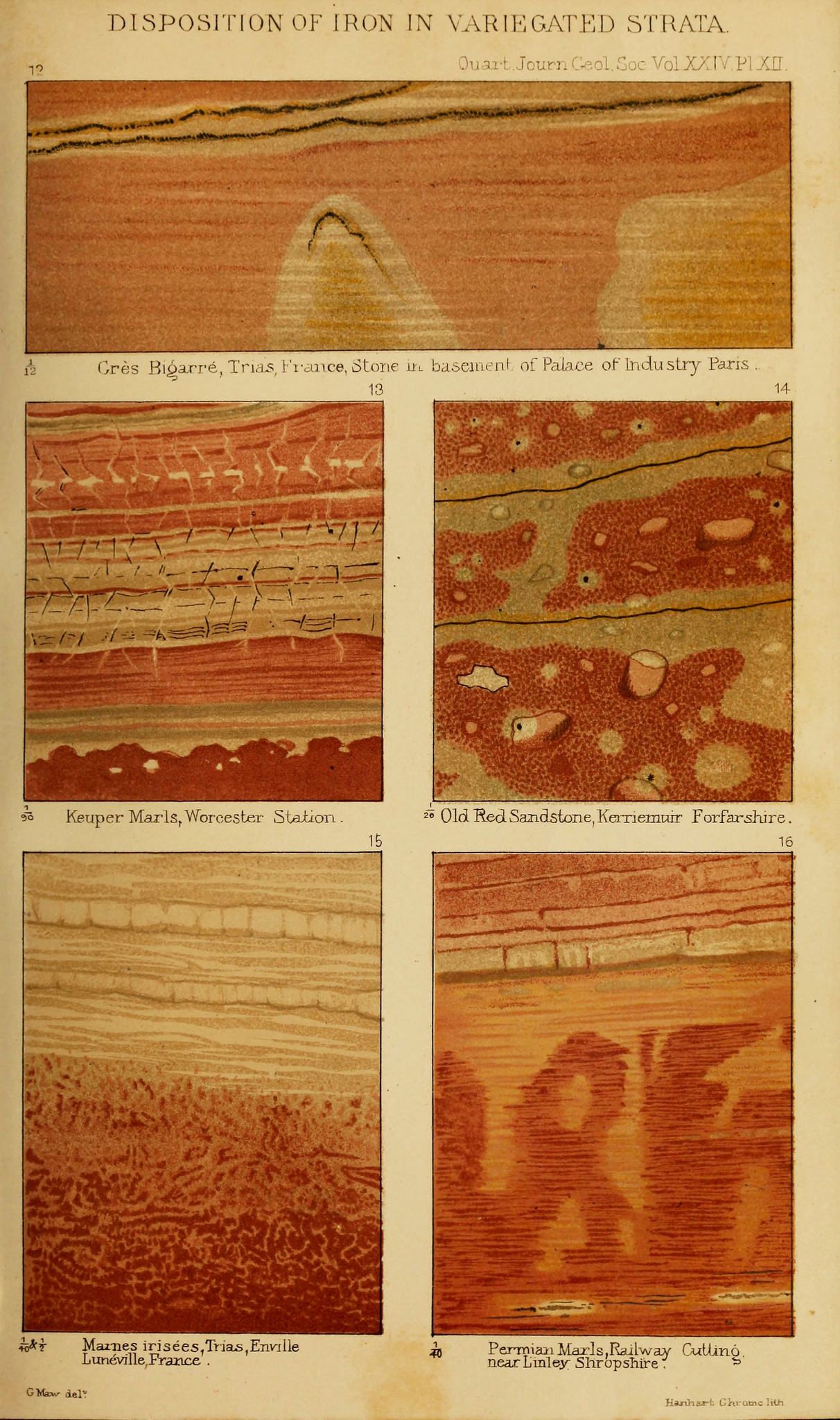
The image is a vintage scientific illustration titled "Disposition of Iron in Variegated Strata". It's a plate from the "Quart. Journ. Geol. Soc. Vol.XXIV.PL.XI". The plate features six rectangular panels, each showcasing a different geological sample or rock formation. Here's a breakdown of each panel: 1. **Top Left (12):** A close-up of a stone with a mottled, reddish-brown and cream pattern. It's labeled "Crès Bigarre, Trias, France. Stone in basement of Palace of Industry Paris." 2. **Top Middle (13):** A highly textured rock with swirling patterns of reddish-brown, cream, and dark brown. It appears to be a cross-section of layered sediment. 3. **Top Right (14):** A rock with a more uniform, but still variegated, pattern of reddish-brown and cream. The layers are less distinct than in the previous samples. 4. **Middle Left (15):** A sample of "Keuper Marls, Worcester Station". It shows thin, horizontal layers of light and dark brown sediment. 5. **Middle Right (16):** A sample of "Old Red Sandstone, Kelmemir, Forfarshire". It's a reddish-brown rock with some darker streaks and a slightly grainy texture. 6. **Bottom Left (17):** A sample of "Marnes irisées, Trias, Enville Lunéville, France". It shows thin, wavy layers of reddish-brown and cream. 7. **Bottom Right (18):** A sample of "Permian Marls, Railway Cutting near Linley, Shropshire". It's a reddish-brown rock with some darker streaks and a slightly grainy texture. The overall color palette is dominated by shades of reddish-brown, cream, and dark brown, reflecting the iron-rich nature of the geological samples. The illustrations are detailed and appear to be hand-drawn or lithographed. The background of the plate is a faded yellow-beige. The text is in a classic serif font. The plate is labeled with numbers and descriptions for each sample.