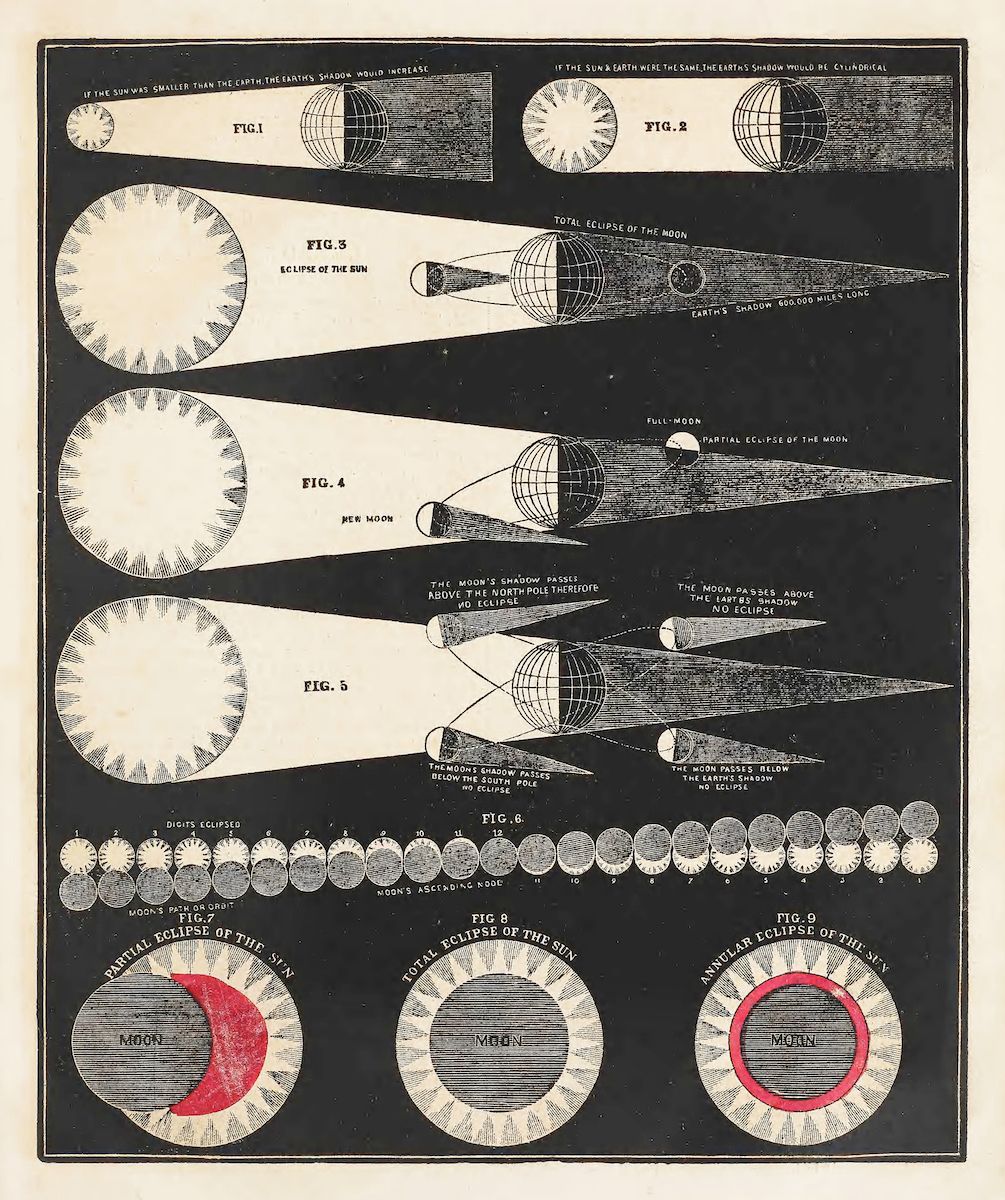
This is a vintage scientific illustration depicting various stages and types of solar and lunar eclipses. The background is a dark, almost black, color, and the illustrations are primarily white lines on a black background. The image is divided into nine labeled figures (Fig. 1 through Fig. 9). Each figure illustrates a different aspect of eclipses. * **Fig. 1** shows a diagram explaining how the Earth's shadow would increase if the Sun were smaller than the Earth. * **Fig. 2** illustrates what would happen if the Sun and Earth were the same size, resulting in a cylindrical Earth's shadow. * **Fig. 3** depicts a solar eclipse, showing the Moon passing between the Sun and Earth, casting a shadow on Earth. * **Fig. 4** shows a full moon and the concept of a 'new moon'. * **Fig. 5, 6, and 7** illustrate different scenarios of the Moon's shadow passing above or below the Earth, resulting in no eclipse. * **Fig. 8** shows a total eclipse of the sun, with the moon completely obscuring the sun. * **Fig. 9** depicts an annular eclipse of the sun, where the moon is too far from Earth to completely cover the sun, leaving a bright ring around the moon. Each illustration uses circles and arcs to represent the Sun, Moon, and Earth, and lines to indicate the path of the shadows. There is text labeling each figure and explaining the concepts illustrated. The style is reminiscent of 19th or early 20th-century scientific diagrams, with a focus on clarity and precision.