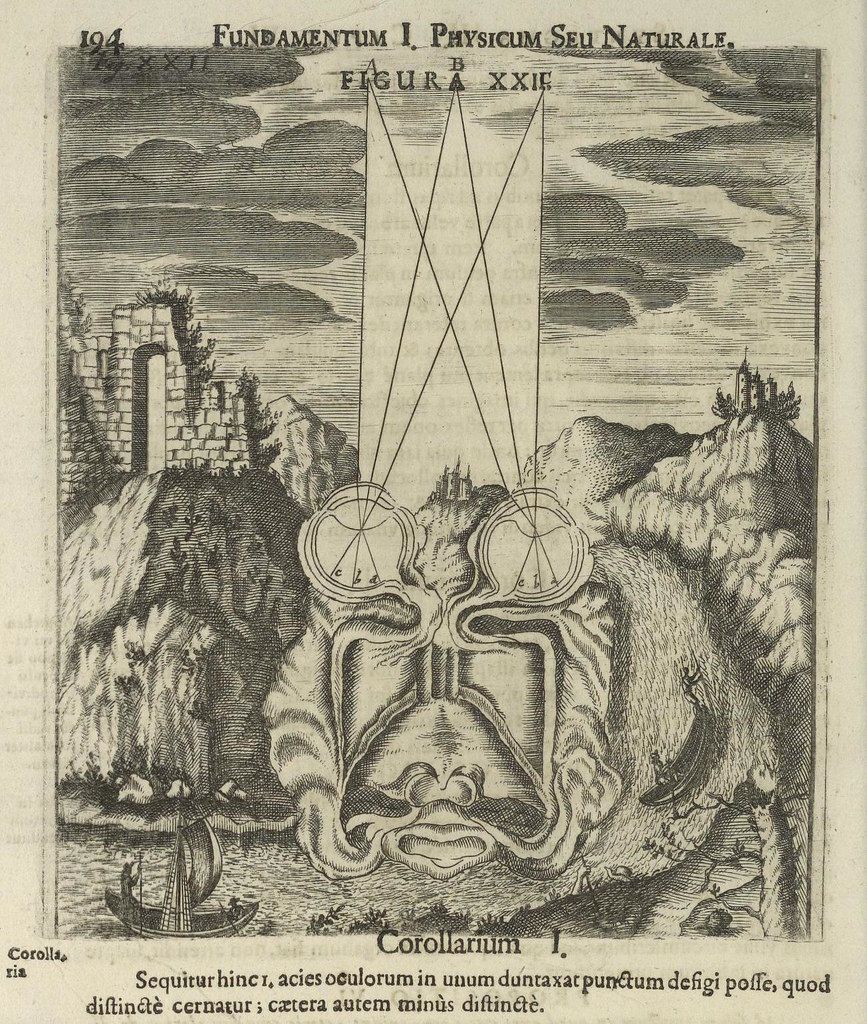
This is a detailed black and white engraving from a historical scientific text. The image depicts a landscape with a focus on the human eye and vision. **Central Focus:** Two large, stylized human eyes are positioned on either side of a central, undulating line that represents a pathway or nerve. The eyes are depicted in profile, showing the pupil, iris, and surrounding structures. Light rays converge from above onto the eyes, and then travel along the undulating line towards a central point. **Landscape:** The eyes are situated within a hilly landscape. On the left side, there's a small castle or tower structure atop a hill. Scattered trees and vegetation cover the hillsides. The background features a hazy sky. **Text:** Above the image, there's text in Latin: "FUNDAMENTUM I. PHYSICUM SEU NATURALE. FIGURA XXI.". Below the image, there's more Latin text: "Corollarium I. Sequitur hincr, acies oculorum in unum duntaxat punctum defigi posse, quod diftincte cernatur; cætera autem minus diftincte.". The style of the engraving is typical of scientific illustrations from the 16th or 17th century, with a focus on detailed anatomical representation and a somewhat stylized depiction of the landscape. The image likely illustrates a concept related to optics, vision, or the nervous system.