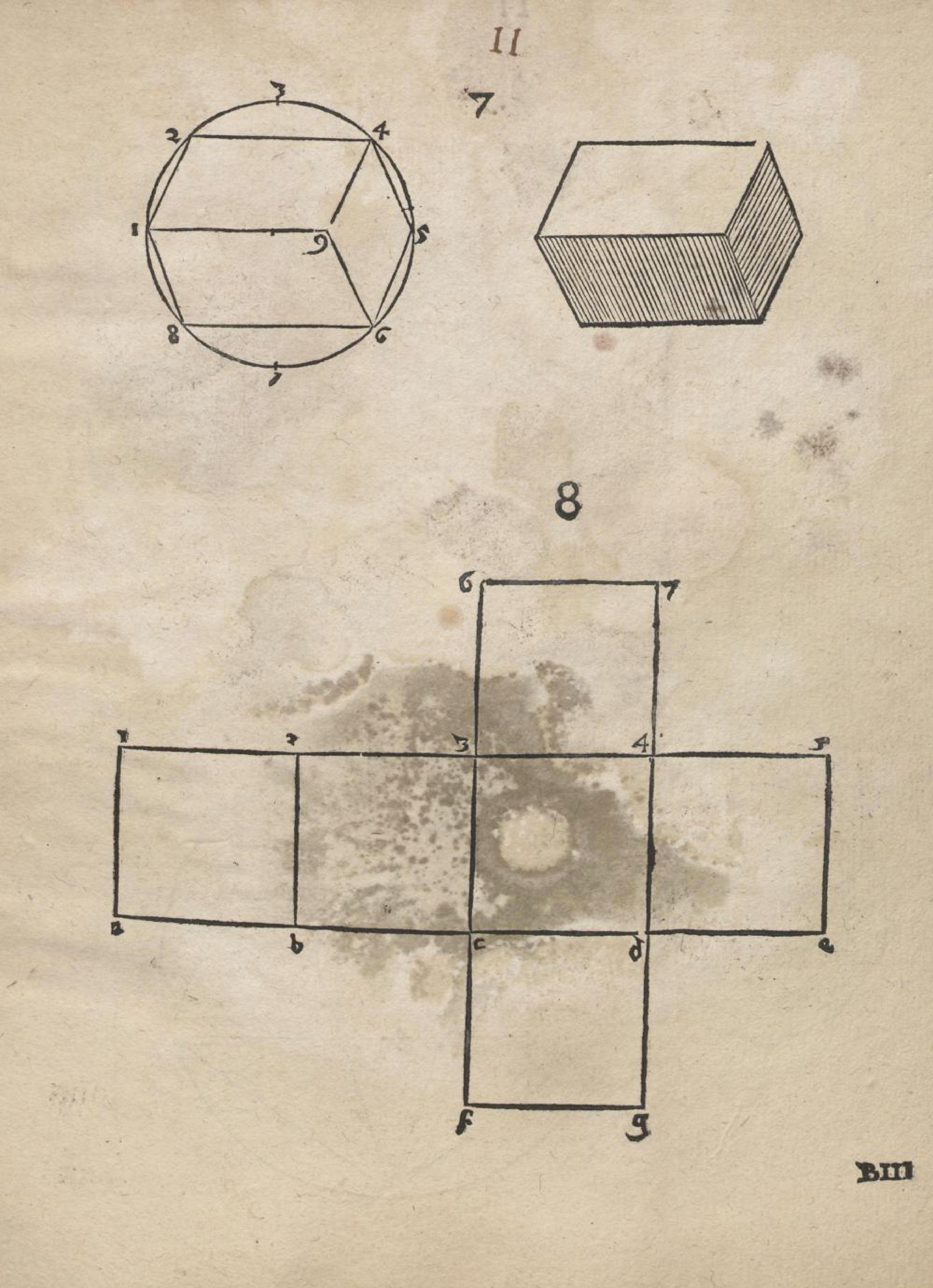
The image is a vintage, aged diagram with a yellowish-brown tone, likely from an old book or manuscript. It features three distinct geometric illustrations. At the top left is a heptagon (a seven-sided polygon) inscribed within a circle. Each vertex of the heptagon is labeled with a number from 1 to 7. Lines connect the center of the circle to each vertex. To the top right is a simple isometric cube, rendered with parallel lines to suggest depth and volume. Below these, taking up the majority of the image, is a net of a cube. It's composed of six squares connected to form a cross-like shape. Each square is labeled with a letter (a, b, c, d, e, f, g) and a number (1-6) to indicate its position in the unfolded cube. The paper has significant staining and discoloration, particularly in the center of the cube net, obscuring some of the details. The numbers and letters are handwritten in a style typical of older texts. At the top of the image, above the heptagon and cube, are the numbers 'II' and '7'. At the bottom right corner is the number 'Bm'. The number '8' is placed above the cube net. The overall impression is that this is a mathematical or geometric illustration from a historical source.