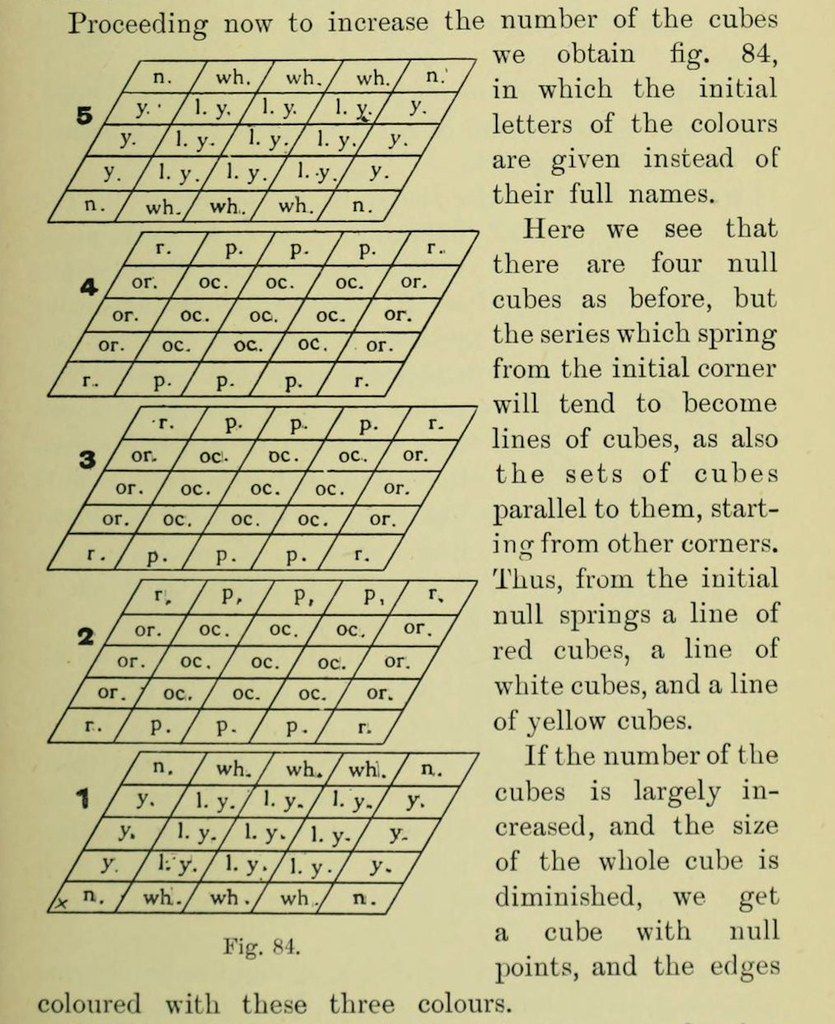
The image shows a series of five diagrams representing cubes, numbered 1 through 5. Each cube is constructed from smaller cubes arranged in a 3x3x3 grid. The smaller cubes are colored with three colors: yellow (y), white (wh), and orange (or). The diagrams demonstrate a progression in the arrangement of these colors. **Diagram 1:** The bottom layer consists of white cubes, the middle layer of yellow cubes, and the top layer of white cubes. The sides are orange. **Diagram 2:** The bottom layer is orange, the middle layer is yellow, and the top layer is orange. The sides are white. **Diagram 3:** The bottom layer is orange, the middle layer is yellow, and the top layer is orange. The sides are white. **Diagram 4:** The bottom layer is orange, the middle layer is yellow, and the top layer is orange. The sides are white. **Diagram 5:** The bottom layer is orange, the middle layer is yellow, and the top layer is orange. The sides are white. To the right of the diagrams is text describing the progression. It notes that as the number of cubes increases, the series of colored cubes will tend to become lines of cubes parallel to each other, starting from other corners. The text also mentions that from the initial null point, lines of red, white, and yellow cubes will spring forth. The text also states that if the number of cubes is largely increased and the size of the whole cube is diminished, one will get a cube with null points and edges colored with these three colors.