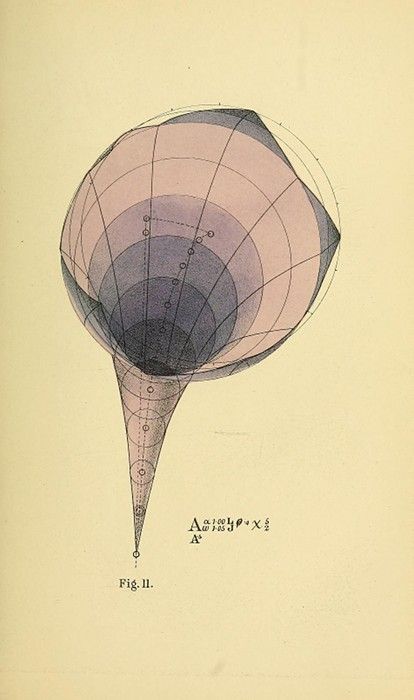
The image is a vintage scientific diagram, likely from a physics or chemistry textbook. It depicts a complex, three-dimensional shape resembling a distorted cone or bulb. The shape is rendered with a network of thin, dark lines that create a grid-like structure across its surface. These lines converge towards a narrow point at the bottom, forming a conical base. The upper portion of the shape is more rounded and bulbous, with the lines curving and intersecting to define its form. Within the shape, there's a gradient of shading, transitioning from a darker tone at the top to a lighter tone towards the bottom. This shading suggests depth and volume. Small circles are scattered along the lines within the shape, possibly indicating points of measurement or data. Below the diagram, there's a mathematical formula written in a stylized font. It appears to be a chemical or physical equation, with symbols and exponents. The text reads: 'A^(α+0.6) * Y^(0.4) * X^(1/2) / A'. At the very bottom of the image, there's a caption that reads 'Fig. II.' The background is a pale yellow or cream color, typical of aged paper. The overall aesthetic is reminiscent of early 20th-century scientific illustrations.