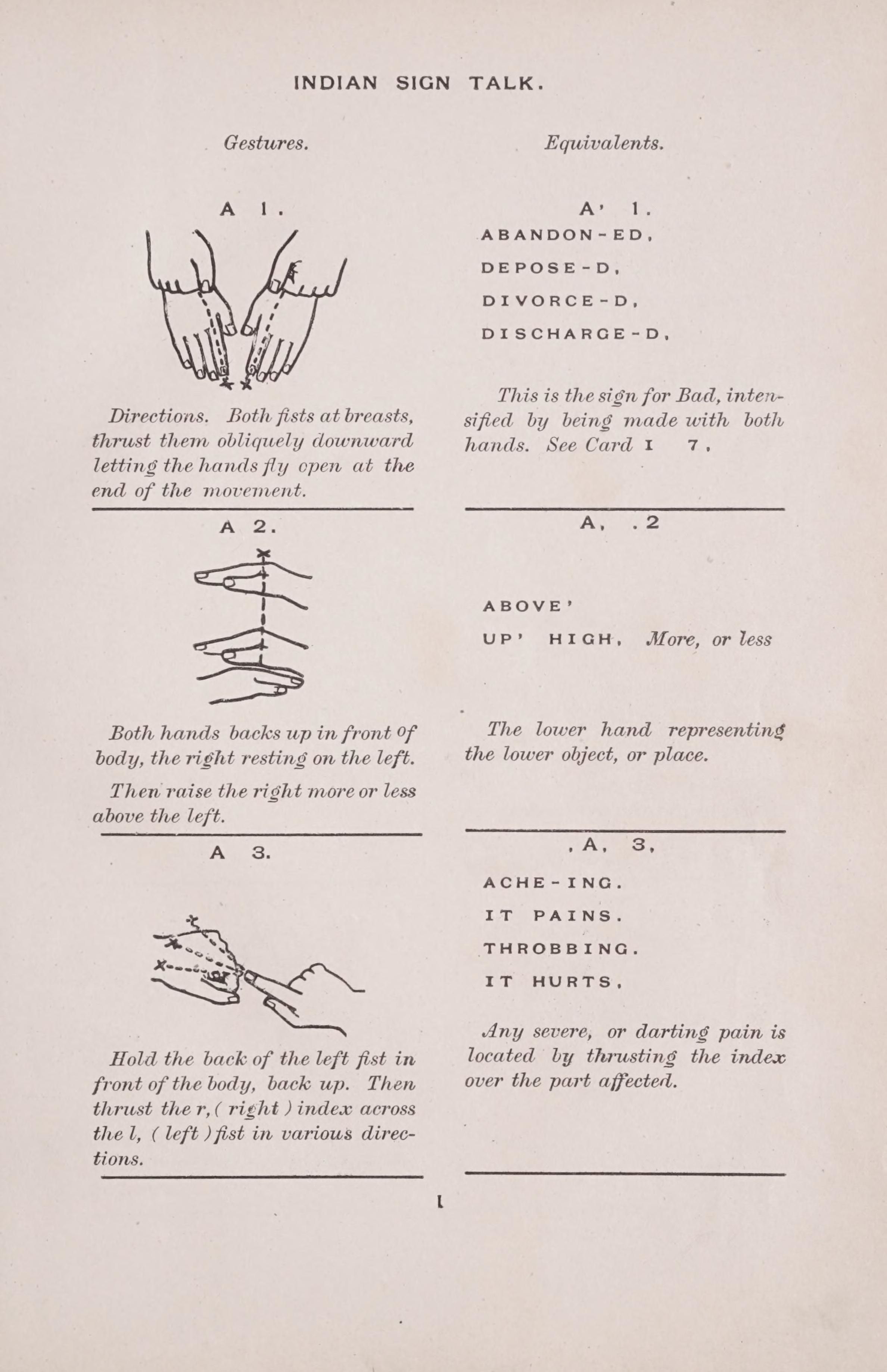
The image is a page from a manual on Indian Sign Talk, detailing hand gestures and their corresponding meanings. It's a black and white illustration with a vintage aesthetic, likely from the early 20th century. The page is divided into two columns: 'Gestures' and 'Equivalents'. **Gestures Column:** * **A 1:** Shows both fists at the chest, with an arrow indicating a downward and outward thrusting motion. The hands are open at the end of the movement. * **A 2:** Depicts both hands raised in front of the body, with the right hand resting on the left. An arrow indicates the right hand being raised more or less above the left. * **A 3:** Illustrates the back of the left fist in front of the body, with the right index finger thrusting across the left fist in various directions. **Equivalents Column:** * **A' 1:** Lists the meanings of the first gesture as 'Abandon-D', 'Depose-D', 'Divorce-D', and 'Discharge-D'. * **A, 2:** Defines the second gesture as 'Above', 'Up', and 'High', with the addition of 'More, or less'. * **A, 3:** Explains the third gesture as 'Ache-ing', 'It pains', 'Throbbing', and 'It hurts'. It also notes that any severe or darting pain is located by thrusting the index over the part affected. The illustrations are simple line drawings, and the text is in a clear, old-fashioned font. A horizontal line separates the three gesture/equivalent pairs. The page number '1' is visible at the bottom right corner. The overall impression is of a historical document used for teaching a visual language.