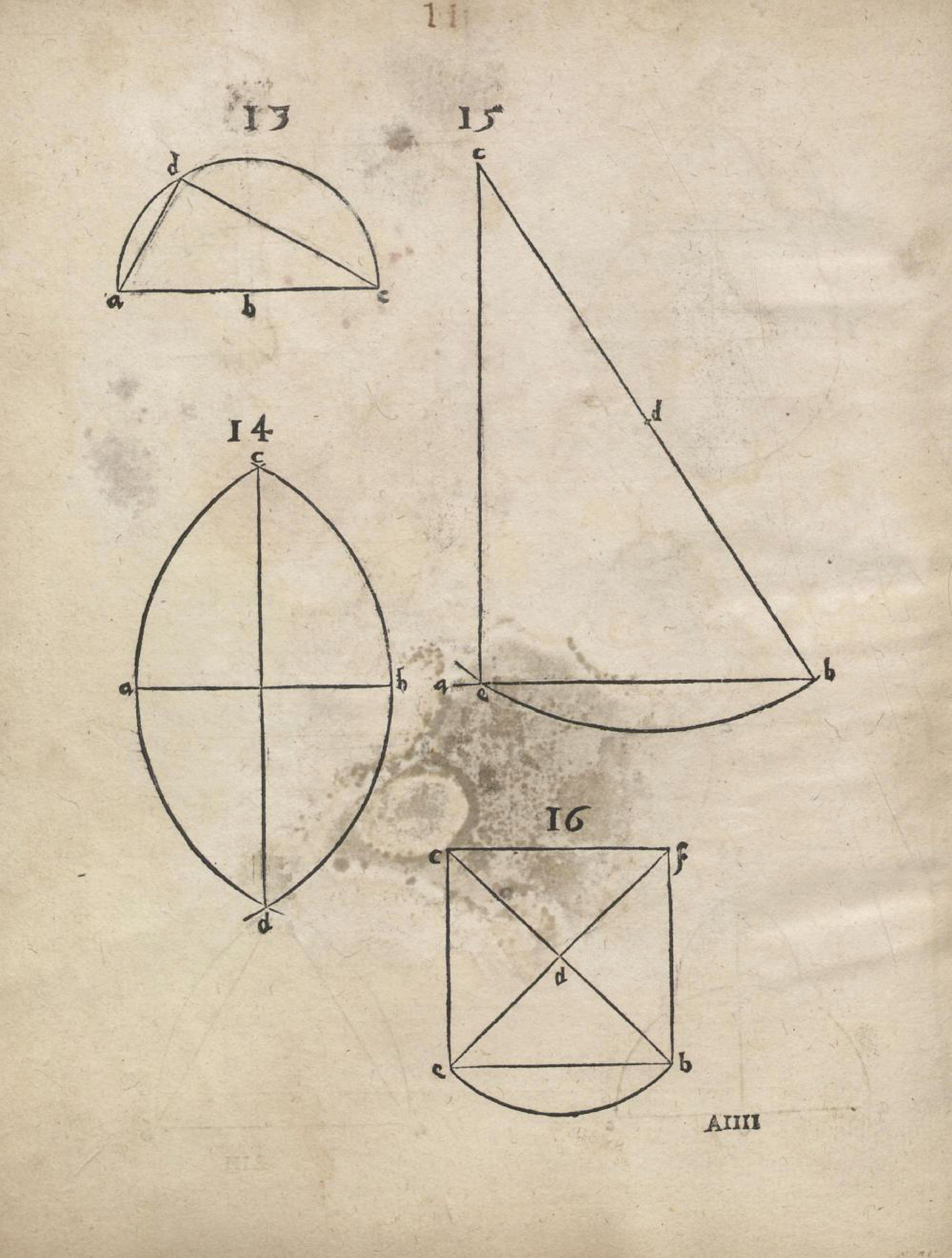
This is a vintage, hand-drawn diagram from a mathematical or geometric text. The paper has a yellowish, aged tone. The diagram consists of four distinct geometric figures, each labeled with a Roman numeral (14, 15, 16, 17) and lettered points. **Figure 14:** A large, vertically oriented ellipse or oval is centered. It's bisected by a vertical line and a horizontal line, creating four quadrants. Points 'a', 'd', 'b', and 'e' are marked on the ellipse's perimeter. A vertical line connects 'a' and 'd', and a horizontal line connects 'b' and 'e'. The intersection of these lines is labeled 'h'. **Figure 15:** A tall, slender triangle with vertices labeled 'c', 'd', and 'e'. Lines connect these points to form the triangle. A vertical line bisects the triangle. **Figure 16:** A square with vertices labeled 'c', 'f', 'b', and 'e'. Inside the square, a smaller triangle with vertices 'd', 'b', and 'e' is drawn, connecting to the corners of the square. A curved line intersects the bottom corners of the square. **Figure 17:** A curved arc with points 'a', 'b', and 'c' marked on it. A triangle is drawn with vertices 'a', 'b', and 'c', connecting to the arc. Each figure is labeled with a Roman numeral, and points within the figures are labeled with lowercase letters. The lines are thin and appear to be drawn with ink. The overall style is reminiscent of early mathematical illustrations.