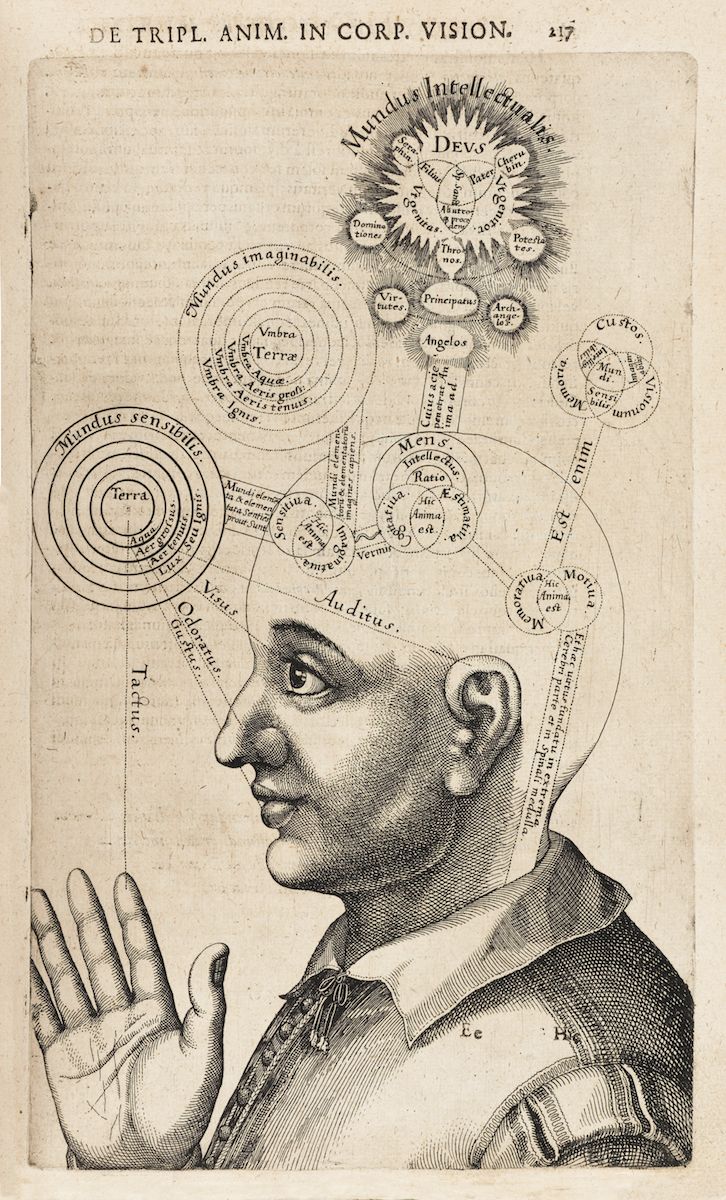
This is a detailed, antique engraving depicting a complex diagram overlaid onto a profile view of a man's head and upper body. The image is titled 'De Tripl. Anim. In Corp. Vision' at the top, with '217' in the upper right corner. The man is depicted in profile, facing left. He has a strong nose, a closed mouth, and a focused gaze. His hair is short and neatly styled. He is wearing a dark, textured robe or garment with a high collar. His left hand is raised, palm open, as if in a gesture of presentation or explanation. Overlaid on the head is a complex diagram composed of concentric circles and interconnected lines. These circles are labeled with Latin terms and represent different aspects of perception and cognition. The diagram is divided into sections labeled 'Mundus Sensibilis' (sensible world), 'Mundus Imaginabilis' (imaginary world), and 'Mundus Intellectualis' (intellectual world). Within these sections are further labels and symbols representing senses like 'Tactus' (touch), 'Visus' (sight), 'Auditus' (hearing), and 'Odoratus' (smell). The diagram also includes terms related to the mind, intellect, and spiritual realms, such as 'Ratio' (reason), 'Anima' (soul), 'Angeli' (angels), and 'Deus' (God). The engraving is executed in a fine, detailed style, with intricate shading and cross-hatching. The overall impression is one of intellectual complexity and philosophical inquiry. The image appears to be a visual representation of a medieval or Renaissance theory of the mind and the senses.